
Ways to reduce food aggregator commissions legally
The commission on an aggregator order isn’t the only cost lever a UAE restaurant can control. The practical answer to how to reduce food aggregator commissions legally is to encourage repeat customers to order through channels you control, negotiate platform rates and placements, and increase order value. Gaurav Varma of The Royal Orchid Group of Restaurants Abu Dhabi has cited UAE aggregator commissions of 25 to 30 per cent, while Bhanu Pratap Rathore of GrowthX Advisors has cited rates reaching 35 per cent.
It’s understandable to focus on commission rates, but the real impact also depends on how many orders come through each platform and what each order earns after discounts and deductions. Follow the terms of your agreements, and make direct ordering a clear, convenient option for customers who choose it.
This guide covers practical ways to grow direct orders, review platform charges, and improve order value without relying on guesswork. It also explains how connected restaurant technology can help manage menus and orders across channels, making operations easier to oversee.
Key Takeaways
- Make direct ordering easy with QR menus, WhatsApp, and clear prompts for repeat customers.
- Assess platform costs by looking beyond the base commission to discounts, advertising, and other contract charges.
- Use order volume, customer satisfaction, and sales records to support commission negotiations with aggregators.
- Raise basket value with relevant add-ons and bundles, then compare the extra revenue with any added platform charges.
- Review aggregator contracts carefully and keep direct-order promotions within the terms you’ve agreed to.
1. Direct ordering through QR menus, WhatsApp, or direct calls
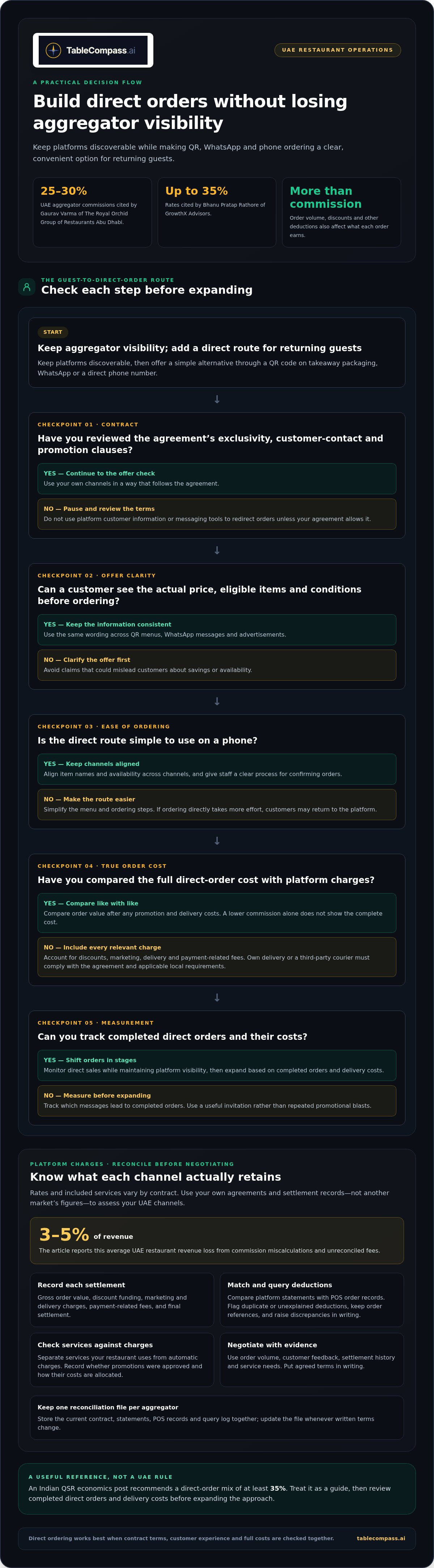
Build a direct-order route without switching off aggregator visibility. Gaurav Varma of The Royal Orchid Group of Restaurants Abu Dhabi said restaurants seeking strong online visibility need to advertise regularly with aggregators. Keep those platforms discoverable, then give returning guests a simple alternative: a QR code on takeaway packaging, a WhatsApp contact, or a direct phone number.
For a UAE promotion, make the offer easy to understand: show the actual price, eligible items, and any conditions before customers order. Keep the wording consistent across your QR menu, WhatsApp messages, and advertisements, and avoid claims that could mislead customers about savings or availability.
Before encouraging direct orders, review your aggregator agreement for exclusivity, customer-contact, and promotion clauses. Invite customers to use your own channel through packaging or in-store materials. Don’t use platform customer information or messaging tools to redirect orders unless your agreement allows it.
Keep your channels working together. A customer might discover your restaurant on an aggregator, reorder through WhatsApp, and call with a special request. Make the direct menu easy to use on a phone, align item names and availability across channels, and give staff a clear process for confirming orders. If ordering directly takes more effort, customers may return to the platform.
Use a useful message rather than repeated promotional blasts. For example, place a QR code on takeaway packaging with a note inviting the guest to view the menu and order directly next time. State offer terms clearly, and track which messages lead to completed orders. Don’t assume a discount improves margins: compare the direct order’s value with its promotion and delivery costs.
UAE restaurants can use their own delivery staff or a third-party courier where the arrangement complies with their aggregator contract and applicable local requirements. Compare the full delivery cost with the platform’s charges before moving orders. A lower commission alone doesn’t show the complete cost.
Ending an aggregator agreement or shifting orders can affect platform visibility and may lead to disputes if notice, exclusivity, or other terms are ignored. Keep the agreement, order records, and written communications together. Shift orders in stages so you can monitor direct sales while maintaining platform visibility.
Make the transition measurable. Some restaurants and home chefs have used WhatsApp groups to take orders without paying an aggregator a cut, with delivery arranged through services such as Dunzo. In Saudi Arabia, restaurants can retain aggregators for customer exposure while encouraging future direct orders, including through QR codes and offers on takeaway packaging. One suggested approach is to message customers about direct ordering after their third aggregator order.
A post on Indian QSR economics recommends targeting a direct-order mix of at least 35%. Treat that target as a guide, then review completed direct orders and delivery costs before expanding the approach.
2. UAE aggregator commission rates
For a UAE restaurant, base commission decisions on your platform agreements and settlement records. Rates and included services vary by contract, so figures from another market won’t establish what your restaurant should pay. For each UAE channel, calculate the amount retained from completed orders over the same accounting period.
Build a worksheet that separates base commission from other deductions. Record gross order value, discount funding, marketing and delivery charges, payment-related fees, and the final settlement. Calculate each deduction as a share of the relevant sales value. This helps show whether costs come from commission, promotions, or additional services.
Reconciliation matters. UAE restaurants lose an average of 3-5% of revenue due to commission miscalculations and unreconciled fees. Match platform statements against POS order records, flag duplicate or unexplained deductions, and retain supporting order references. Raise discrepancies in writing and track the platform’s response against each entry.
Compare the services received with the deductions. A platform may provide promotional placements or other services, and delivery and payment arrangements can differ. Separate services your restaurant actively uses from charges applied automatically. For promotion-related fees, record whether the restaurant approved the promotion and how the agreement allocates its cost.
Use transaction data in negotiations. Present order volume, customer feedback, settlement history, and the services your restaurant needs. Make a specific request, such as clearer approval rules for marketing charges or a revised commission structure. Get any agreed terms in writing so both parties have a clear record.
For a commission dispute in the UAE, start with the contract’s dispute-resolution clause and follow its stated process. A UAE-qualified commercial lawyer can review the agreement, governing-law wording, and jurisdiction. Provide the signed contract, settlement statements, order records, and written exchanges so the adviser can assess the dispute using your restaurant’s documents.
Keep a reconciliation file for each aggregator, with the current contract, statements, POS records, and a log of queries. Update it whenever written terms change, so finance staff refer to the correct agreement when reviewing deductions. This gives you a UAE-specific view of net proceeds and service value based on your restaurant’s transactions.
3. Food delivery platform commission rates
UAE aggregator commissions vary by platform and commercial agreement. Gaurav Varma, CEO of The Royal Orchid Group of Restaurants Abu Dhabi, said aggregators charged restaurants 25 to 30 per cent on orders. Bhanu Pratap Rathore, managing partner of GrowthX Advisors, said charges could reach 35 per cent. These are reported market figures, not a guaranteed rate for every UAE restaurant.
Compare offers using the same order value and accounting period. Record each platform’s base commission, marketing charges, delivery deductions, payment fees, discounts, and net settlement. Include the services attached to those charges, such as promotional placement or delivery arrangements. This side-by-side view helps reveal whether a lower headline rate comes with additional fees or fewer services.
UAE restaurants can negotiate lower commission rates with aggregators. Present documented order volume, customer satisfaction measures, sales patterns, and the services your restaurant uses. Make a specific request, such as changing the base rate or clarifying charges for optional marketing, and keep the agreed terms in writing.
Review the contract schedule alongside settlement statements. Check how commissions are calculated, which order value they apply to, and whether discounts affect the calculation. Identify marketing placements that require approval, delivery charges billed separately, and payment deductions. Match every settlement line to the relevant contract clause to understand how it is charged.
Terms that can help control total fees include a clearly defined commission basis, written approval for paid marketing, transparent delivery and payment charges, and a process for disputing statement errors. Review discount funding, settlement timing, and how contract changes take effect. Clear provisions make charges easier to understand and give both parties practical points for negotiation.
Rathore said UAE restaurants were left with five to seven per cent margins after operating costs. Reconcile completed orders with settlement statements, then flag deductions that don’t match the contract. Keep records of order references, invoices, promotion approvals, and written platform responses. A consistent audit trail helps operators identify discrepancies and discuss them using specific evidence.
Use a comparison sheet for each UAE platform. Include gross order value, every deduction, net settlement, and the services received. Review the figures regularly and bring documented questions to renewal discussions. This helps restaurant operators assess total commercial value, negotiate clearer terms, and avoid judging an offer by its base commission alone.
Apply these findings to platform discussions, using comparable rates as negotiation references rather than guaranteed UAE terms. San Francisco limited third-party delivery platforms to charging local restaurants no more than 15 per cent commission during the Covid-19 pandemic. For fine-dining restaurants, commission rates may be negotiated to 15-20%. Premium Talabat restaurant partners may negotiate base commission rates of 15-20%, while multi-location restaurant chains may negotiate Talabat commission rates of 18-22%. SFC Group director Rohith Muralya proposed charging restaurants five per cent for the marketplace component of delivery orders and 10 per cent for logistics on delivery orders. These figures offer reference points, but proposals may cover different services. Ask for a written breakdown of what each rate includes, how it is calculated, and whether it changes with order volume or added services. Record any agreed rate and related conditions in the contract, then compare settlement deductions against those terms.
4. Increasing order value to improve effective rates
A larger basket can make fixed order charges smaller relative to sales, but it won’t lower a percentage commission by itself. If a customer adds items, the commission rises with the order value unless the contract changes the rate. One practical part of how to reduce food aggregator commissions legally is to grow profitable basket value, not just gross order value.
Start with items customers already buy together. Pair a main dish with a suitable side, or suggest a drink that complements the meal. Keep the choice optional and show the bundle price clearly on the menu. Compare sales and contribution margins for bundle orders with similar orders without the offer. A higher average order value helps only if extra items remain profitable after preparation, packaging, and applicable platform deductions.
Use menu placement to make relevant add-ons easy to notice. Put a side dish beside the main item, describe portion sizes accurately, and avoid making customers search through unrelated categories. A family meal bundle, for example, can combine dishes suited to sharing, while a single-diner offer can present a practical extra. Review which options customers select, and remove combinations that add complexity without improving order economics.
Apply the same margin test to promotions. A discount may increase basket size while reducing what the restaurant retains, especially if the platform calculates commission on the discounted order value or charges for promotion participation. Read the agreement’s discount terms, record who funds each offer, and compare settlement statements with menu prices. More orders don’t necessarily mean stronger returns, so check net proceeds and promotion costs.
For a simple check, record gross value, base commission, additional charges, discount funding, and settlement for each order type. Repeat the calculation for orders with an add-on or bundle. If fees include fixed charges, a larger basket can reduce them as a share of revenue. Percentage-based fees, however, rise with order value. Separate these charge types before deciding which menu change could improve returns.
Restaurants deciding how to reduce food aggregator commissions legally can test one menu adjustment at a time. Keep menu and pricing details consistent across channels, and explain bundle conditions before checkout. Compare results by item, ordering channel, and promotion rather than relying on a single blended average. This gives operators a practical basis for adjusting portions, placement, and offers while protecting contribution margin. The aim is not simply a bigger order, but a more profitable one after applicable deductions.
5. What UAE laws and regulations govern food aggregator commissions and restaurant contracts?
For a UAE restaurant, the signed aggregator agreement is the starting point for understanding commissions. Read the commercial schedule alongside clauses covering deductions, promotions, payment, delivery, exclusivity, changes, termination, and disputes. The contract wording matters: a quoted base rate alone doesn’t explain every amount that may appear in a settlement statement.
Separate contract terms from wider legal requirements. Don’t assume there is a single commission cap or apply rules from India, Saudi Arabia, or another market to a UAE agreement. For a specific dispute, check which law governs the contract, which jurisdiction handles disputes, and whether the agreement requires negotiation, arbitration, or court proceedings. Read those details in the signed documents.
Before signing or renewing, record the key clauses. Note the commission calculation basis, charges for marketing or delivery, treatment of discounts, settlement timing, and process for challenging statement errors. Check whether a platform can change rates or services unilaterally, how it gives notice, and whether the restaurant can decline optional promotions. Get negotiated terms in writing and retain the final version.
For an existing account, reconcile one settlement period at a time. Match order records to settlement lines, then compare each deduction with the relevant clause and any written promotion approval. Keep invoices, statements, order reports, emails, and contract versions together. If a charge appears inconsistent, identify the exact order or clause, state the amount in AED, and request a written explanation through the contract’s dispute process.
A UAE-qualified commercial lawyer can assess the governing-law and dispute-resolution clauses, the parties’ obligations, and the available route for resolving a disagreement. Give the adviser the signed contract, amendments, settlement evidence, and written exchanges. This lets the review focus on the actual wording and records, rather than assumptions based on another country’s platform practices.
Keep a simple contract register for every aggregator. Record the current rate schedule, effective written changes, renewal or termination dates, and the contact channel for disputes. Assign a manager to update it whenever terms change. This helps prevent outdated terms from being used in negotiations and gives finance staff a consistent reference for checking deductions.
Clear operational records also strengthen contract administration. Restaurants connecting order and settlement data across POS and aggregator channels can organize POS and aggregator workflows alongside their contract records. Use that information to spot differences, document questions, and keep commercial discussions grounded in the restaurant’s own transactions.
TableCompass.ai: OmniSync
TableCompass.ai’s OmniSync connects restaurant POS systems with food aggregators, helping UAE operators coordinate these connections through middleware. It’s a practical next step when orders across platforms create fragmented workflows or make day-to-day coordination harder.
Use OmniSync as part of a wider channel setup. Atlas Menu Management provides centralized menu control, while a White-Label Mobile App can give your restaurant its own ordering channel. These tools support workflows for aggregator and direct orders, but don’t change commission terms or replace careful review of each platform contract.
If your restaurant needs to coordinate POS and aggregator operations, contact TableCompass.ai to discuss how OmniSync can support your workflow.
Build a stronger ordering mix from here
For UAE restaurants, deciding how to reduce food aggregator commissions legally is an ongoing operating choice, not a one-time negotiation. Set a regular review routine: compare channel performance, revisit contract terms before renewal, and adjust direct-order offers as customer behaviour changes. Base decisions on your own transactions, not assumptions about platform rates.
Make the next step manageable. Start with one area to improve, such as reconciling platform statements or simplifying repeat orders. Assign responsibility for tracking the change and reviewing its effect on net sales. GuestConnect AI supports customer engagement through intelligent automation, helping restaurants build stronger connections with guests across their ordering journey.
For connected restaurant operations, TableCompass.ai offers OmniSync and Atlas Menu Management to support aggregator and menu workflows. Contact TableCompass.ai to discuss how these tools fit your operation.
Contact TableCompass.ai for restaurant support and take the next step toward a more controlled, sustainable ordering mix.