Restaurant technology trends 2026 UAE: How delivery, AI and mobile payments are changing restaurants
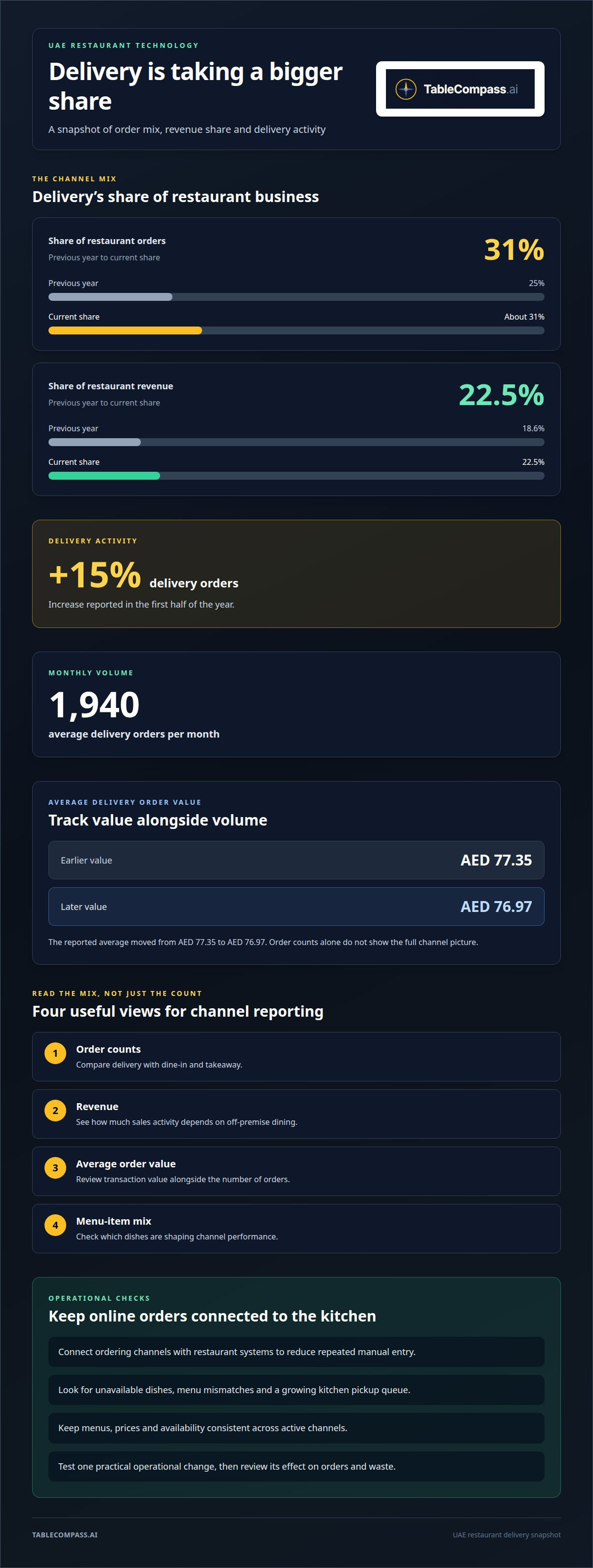
Delivery is still growing in the UAE: it accounted for about 31% of restaurant orders, up from 25% the previous year, and its share of restaurant revenue rose from 18.6% to 22.5%. That makes delivery one of the clearest restaurant technology trends in the UAE in 2026, even as operators work to keep service efficient across dine-in, takeaway and online orders.
For restaurant owners, the shift is bigger than adding another ordering channel. More digital orders can mean more coordination across menus, platforms, payments and kitchen workflows, while AI and automation offer ways to streamline routine tasks and support decisions.
This article explains what the delivery figures mean for UAE restaurants and how AI, connected systems, QR ordering and mobile wallets are reshaping customer journeys and daily operations. You’ll see where technology can reduce friction, where human service still matters, and what to consider when building a setup that keeps orders and teams connected.
Key Takeaways
- Use AI and automation to support forecasting and handle routine customer interactions, while keeping people responsible for service decisions.
- Compare delivery’s share of orders with its share of revenue to understand how the channel is affecting your restaurant’s sales mix.
- Make mobile wallet and digital payment steps easy to use, and connect payment data with the ordering process where possible.
- Assess robotics and kitchen automation around specific workflow bottlenecks, such as repetitive preparation or order handoffs.
- When orders and menus are spread across platforms, connected tools such as OmniSync and Atlas Menu Management can help bring key operations together.
AI-powered chatbots, predictive analytics and automation
AI is moving from experiments into practical restaurant workflows. In 2026, AI-powered sales forecasting is one of the technology trends shaping restaurant operations. For UAE operators, that matters in a market where restaurant visits fell by 10.5% in the first half of the year, and 61% of restaurants saw business slow down. Forecasting tools can help teams plan around demand patterns, rather than relying only on last week’s totals.
Predictive analytics finds patterns in a restaurant’s own records. Managers can review sales by day, time, menu item and ordering channel, then use those patterns to plan purchasing and staffing. For instance, if weekday lunch sales differ consistently from weekend dinner demand, prepare separate forecasts. Treat the system’s output as guidance, and account for local events, promotions and changes in customer behaviour.
Chatbots can answer routine questions before they reach busy staff, such as queries about opening hours, menu items or booking steps. Check that answers reflect current information and that unusual requests can be handled by a person. Keep menu details, availability and operating hours aligned across customer channels. Outdated answers can create more work at the counter.
Automation can also connect tasks that depend on repeated manual entry. When delivery platforms and online ordering connect with restaurant systems, orders can flow into operational workflows with fewer handoffs. A clear digital order flow helps kitchen staff see what needs attention. Map where delays or duplicate entry occur, automate one repeatable step, then review whether errors or staff workload change.
Which UAE restaurant technology providers offer POS, inventory, loyalty, and analytics solutions? TableCompass.ai offers a Restaurant Management System and Restaurant Operation System for restaurant operations. For this specific combination, assess each platform’s stated functions and integrations rather than assuming every module comes bundled.
Use a focused rollout to keep AI useful and manageable:
- Choose a decision. Start with forecasting one area, such as purchasing or staff planning.
- Use relevant records. Compare sales patterns by day, time, menu item and channel.
- Set chatbot boundaries. Automate common answers and route complex requests to staff.
- Review the workflow. Track whether automation reduces repeated entry or kitchen confusion.
AI is most useful as decision support, not an autopilot. A forecast can guide preparation, but managers add context historical data may miss. UAE restaurants often balance dine-in, takeaway and delivery demands. Connect relevant data, keep customer-facing information current, and let staff make the final call when conditions change.
Delivery’s share of restaurant orders and revenue
Delivery is gaining ground in UAE restaurants, but order volume alone doesn’t tell the full story. Delivery orders increased by 15% in the first half of the year, while restaurants averaged 1,940 delivery orders per month. The share of revenue matters too: it shows how much sales activity depends on off-premise dining.
The average UAE delivery order value moved from AED 77.35 to AED 76.97. That small shift alongside rising order activity makes channel-level reporting useful. Compare order counts with revenue, average basket value and menu-item mix. A busy delivery channel may bring more transactions without each order contributing the same amount as before.
Connected ordering systems can make performance comparisons easier. Link online ordering and delivery platforms with restaurant systems to reduce manual re-entry. A shared view can help teams spot unavailable dishes, menu mismatches or a growing kitchen pickup queue. Review performance by channel before changing menu availability or promotions.
How can UAE restaurants compare and choose technology vendors in 2026? Compare providers by how their systems handle order flow, menu updates, inventory records, loyalty activity and reporting. Use a real workflow, such as an online order changing an ingredient’s stock status, to assess how well the tools connect.
How are UAE restaurants using technology to reduce food waste, energy use and operating costs? Teams can use inventory records and sales patterns to plan purchasing, prepare more accurately and identify ingredients that regularly go unused. Operational dashboards can also help managers review equipment schedules and energy use, then adjust routines where consumption is unnecessary.
Keep the review practical: compare delivery, dine-in and takeaway performance, then choose one operational change to test. For example, a manager could mark a dish unavailable when a key ingredient runs low, rather than accept orders the kitchen cannot fulfil. Record the change and review its effect on orders and waste.
Customer communication also shapes the direct-order experience. Some guests prefer a restaurant’s own online channel; others use WhatsApp or delivery platforms. Keep menus, prices and availability consistent across active channels. If a dish appears differently in two places, staff may have to answer avoidable questions during service.
- Compare order volume with revenue and average order value, not in isolation.
- Connect ordering channels to operational records to reduce repeated entry.
- Use inventory and sales patterns to guide purchasing and preparation.
- Review platform menus regularly so guests see consistent information.
Digital payments and mobile wallets
For UAE restaurants, a smooth payment step can shape the final dining impression. Mobile wallets give diners another payment option alongside cards and other available methods. As ordering spans tables, takeaway counters and delivery, make payment choices visible before checkout so guests know what to expect.
Picture a guest scanning a QR code at a Dubai table. They browse the menu, place an order and proceed to payment without waiting for a bill. A wallet option can make the process more direct, while staff remain available for questions. For takeaway, show the total clearly and make the payment action easy to find.
Payment records can help operators understand service. Connect each payment to its order record, then compare transaction totals with orders in the restaurant system. If a guest pays but the order remains open, staff need a clear way to spot and resolve the mismatch. A consistent process helps teams reconcile dine-in and online sales without relying on memory.
What UAE regulations apply to restaurant technology, digital payments, customer data and AI? Restaurants should account for applicable UAE requirements on payment processing and customer data, as well as obligations set by their payment providers. Relevant controls depend on what information is collected, how it is handled and how AI uses it.
Build the guest journey around clarity and choice. Show payment options before a diner submits an order, then provide clear confirmation after payment. Train counter staff to explain the steps without handling a guest’s private credentials. For online orders, ensure the receipt connects to the correct order and channel.
Use this practical sequence to assess the payment experience:
- Map the journey. Follow one order from menu selection through payment and receipt.
- Test each channel. Check dine-in, takeaway and delivery flows separately.
- Match records. Compare payment confirmations with completed orders and refunds.
- Review data access. Limit staff access to information needed for their roles.
Review the process with diners and frontline staff. A guest may need help finding the wallet option, while a cashier needs a simple way to resolve a declined payment. Record recurring questions and errors, then adjust instructions or workflows. The goal is a connected checkout that supports smooth service without making hospitality feel impersonal.
AI adoption in restaurants
AI is most useful when it solves a defined restaurant task. In Dubai, for example, a manager might use an AI tool to group customer feedback by recurring themes, while another team could use it to draft responses for staff review. These applications support decisions and communication, but do not replace the judgement of people who understand the restaurant’s guests and service.
Choose a starting point from a real workflow. List the repeated tasks that slow the team during dinner service, then separate routine information tasks from decisions that need human context. A system might sort incoming feedback, while a manager decides whether a complaint needs a personal response. This makes the tool’s role clear from the start.
Data quality limits the usefulness of results. If menu names differ across records, an AI tool may group the same dish incorrectly. Before adopting a tool, align menu labels, product details and customer feedback categories. Test a defined task using recent, relevant records, then compare the output with what staff know from actual shifts.
What cybersecurity and data-privacy risks do UAE restaurants face when adopting new technology? Risks include exposing customer details, payment-related information or staff accounts through weak access controls or compromised logins. Limit access by role, use strong account security, and understand how a system stores and processes restaurant data.
AI outputs need a clear owner. Assign a manager to review customer-facing text before publication, especially replies about refunds, allergies or service problems. In Abu Dhabi, for example, compare suggested responses with the restaurant’s approved service language. Correct errors, update guidance and keep a person responsible for the final message.
Use this sequence to introduce a tool without disrupting service:
- Define the task. Name one repeatable job, such as sorting guest feedback.
- Prepare the inputs. Remove unrelated records and standardise relevant labels.
- Run a staff review. Compare AI suggestions with human decisions.
- Set access boundaries. Give each team member only the access their role needs.
- Track the workflow. Note errors, corrections and staff time after each review.
Staff confidence matters as much as the software. Explain what the tool can do, what it cannot decide and who checks its output. During a rush of orders, staff should know whether an AI-generated answer is ready to use or needs approval. Clear handoffs protect service quality and prevent automation from creating extra work.
Review the system whenever the restaurant changes its menu, service process or customer communication. A change to the booking process, for instance, can make earlier AI instructions inaccurate. Assign an owner to updates and give staff a simple way to flag mistakes. This keeps AI aligned with the restaurant’s actual operation.
How are robotics and kitchen automation being used by restaurants in Dubai and Abu Dhabi?
In Dubai and Abu Dhabi, kitchen automation can support repetitive tasks and clearer order handoffs. A restaurant might use a robotic appliance for a repeatable preparation step, while digital systems route orders to kitchen staff. The aim is not a fully automated kitchen, but a smoother workflow where people manage quality, timing and guest needs.
Robotics is suited to tasks with consistent inputs and repeatable movements, such as portioning or a standard preparation step. Chefs still oversee recipes, presentation and food quality. Before introducing equipment, map the task from preparation to plating. If staff spend more time cleaning, loading or correcting the machine, it may not solve the bottleneck.
Kitchen display systems offer a practical form of automation without adding a robot. Digital tickets can improve communication between front-of-house and kitchen teams. During a busy Abu Dhabi service, a clear screen helps staff see incoming orders and their status. Keep item names and modifiers consistent so each ticket tells the kitchen what it needs to know.
Cloud kitchens can use modern POS systems to manage orders from multiple delivery platforms and handle high order volumes. The operational benefit comes from connecting order intake with kitchen preparation. A shared workflow lets teams see requests from different channels without switching between separate screens, helping staff prioritise tickets and catch order details before preparation begins.
To evaluate automation, follow a real order through the kitchen:
- Choose a pressure point. Identify a repetitive task or unclear handoff.
- Map the steps. Include order entry, preparation, checking and collection.
- Test one workflow. Observe how staff use the equipment during service.
- Review exceptions. Note what happens with a changed modifier or unavailable item.
- Keep human oversight. Assign staff to check quality and resolve unusual orders.
Robotics also has to fit the physical kitchen. Equipment needs suitable space, a clear task and staff who can operate it safely. Dubai restaurants should assess how it fits existing stations and cleaning routines. Abu Dhabi operators can apply the same test: does it reduce a defined bottleneck without disrupting preparation or service?
Automation works best when order information reaches the kitchen accurately. If your restaurant is improving connected operations, explore restaurant operation systems as part of the workflow planning process. Start with the task, not the machine. That keeps investment decisions tied to real service needs and preserves the judgement and hospitality only people can provide.
TableCompass.ai: OmniSync
For UAE operators handling orders and menus across multiple channels, TableCompass.ai connects restaurant systems with delivery platforms. OmniSync links restaurant POS systems with food aggregators, helping bring order flows together and reduce repeated manual entry.
For UAE operators managing changing menus, Atlas Menu Management provides centralized menu control. GuestConnect AI supports customer engagement through intelligent automation, while a White-Label Mobile App gives restaurants a branded digital channel. Each addresses a different part of the guest and operations journey, so start with the friction point affecting your team most.
Consider these tools when disconnected channels make orders, menus or customer interactions harder to manage consistently. Contact TableCompass.ai to discuss how its offerings fit your restaurant’s workflow.
Build a smarter operating foundation
The next step is not adopting every new tool. It’s choosing one operational gap and deciding how technology should address it. For UAE restaurants, the restaurant technology trends of 2026 point toward connected workflows, where teams can manage change without losing sight of the guest experience.
Start by identifying where information is delayed or duplicated. Define what a better handoff would look like for your team, whether it involves orders, menu updates or customer engagement. TableCompass.ai offers OmniSync, Atlas and GuestConnect AI for connected restaurant operations. Start with the workflow creating the most friction in your restaurant today.
As your priorities become clearer, you can shape a more coherent technology setup around your staff and service model. Contact TableCompass.ai to discuss restaurant technology and explore a practical next step for your operation. A well-designed system should support your people, strengthen daily execution and leave more room for hospitality.
Frequently Asked Questions
What are the biggest restaurant trends in the UAE in 2026?
The biggest UAE restaurant trends in 2026 include connected digital service, AI-supported decisions, contactless ordering and more automated kitchen workflows. Their value depends on fit, not novelty. A neighbourhood café might begin by simplifying table ordering, while a multi-channel operator may focus on keeping service information consistent. Choose a change linked to a current bottleneck, then review guest feedback and staff workload after introducing it.
What technology should UAE restaurant operators prioritise in 2026?
Prioritise technology that addresses your most costly operational friction. Identify where staff lose time or guests encounter confusion, such as menu updates, order handoffs or payment steps. Then map which systems handle the task and where information is repeated. A focused improvement is easier to evaluate than a broad rollout. Set a clear measure, such as fewer corrections or smoother service, before expanding the setup.
What are the top restaurant technology trends in the UAE for 2026?
The leading restaurant technology trends in the UAE for 2026 include AI tools, cloud-based management, QR ordering, contactless dining and connected delivery operations. For an operator, the useful question is how these tools fit together. For example, a menu change should be reflected wherever guests place orders. Consider the whole guest journey, from browsing to fulfilment, rather than selecting technology based on one feature alone.
How are UAE restaurants using AI for ordering, personalization, and kitchen operations in 2026?
UAE restaurants can use AI to assist with order conversations, respond to stated guest preferences and support kitchen planning. An ordering assistant could clarify a requested side dish, while staff handle unusual requests. A manager could also use past sales patterns to inform preparation plans. Keep a person responsible for reviewing customer-facing answers and handling requests that need context.
How are UAE restaurants adopting QR-code ordering, contactless payments, and digital wallets?
Restaurants can offer QR ordering at tables and digital wallet options at checkout, giving diners a self-service route alongside staff assistance. Make the menu easy to read on a phone and show the order total before payment. Provide clear confirmation after checkout and retain a staff-supported option for guests who prefer help. Test the full journey on the devices and ordering channels your guests use.
What restaurant delivery and aggregator technology trends are shaping the UAE market in 2026?
Delivery technology is moving toward better coordination between aggregator orders and restaurant workflows. Assign clear responsibility for updating item availability, monitoring incoming orders and resolving exceptions. Consistent menu information helps prevent orders for unavailable dishes. Review performance by channel and recurring issues, such as missed modifiers or delayed order acceptance, to identify where a process or system connection needs attention.
Which UAE restaurant technology providers offer POS, inventory, loyalty, and analytics solutions?
TableCompass.ai offers a Restaurant Management System and a Restaurant Operation System. Assess each platform’s stated functions and integrations rather than assuming POS, inventory, loyalty, and analytics modules are all bundled.