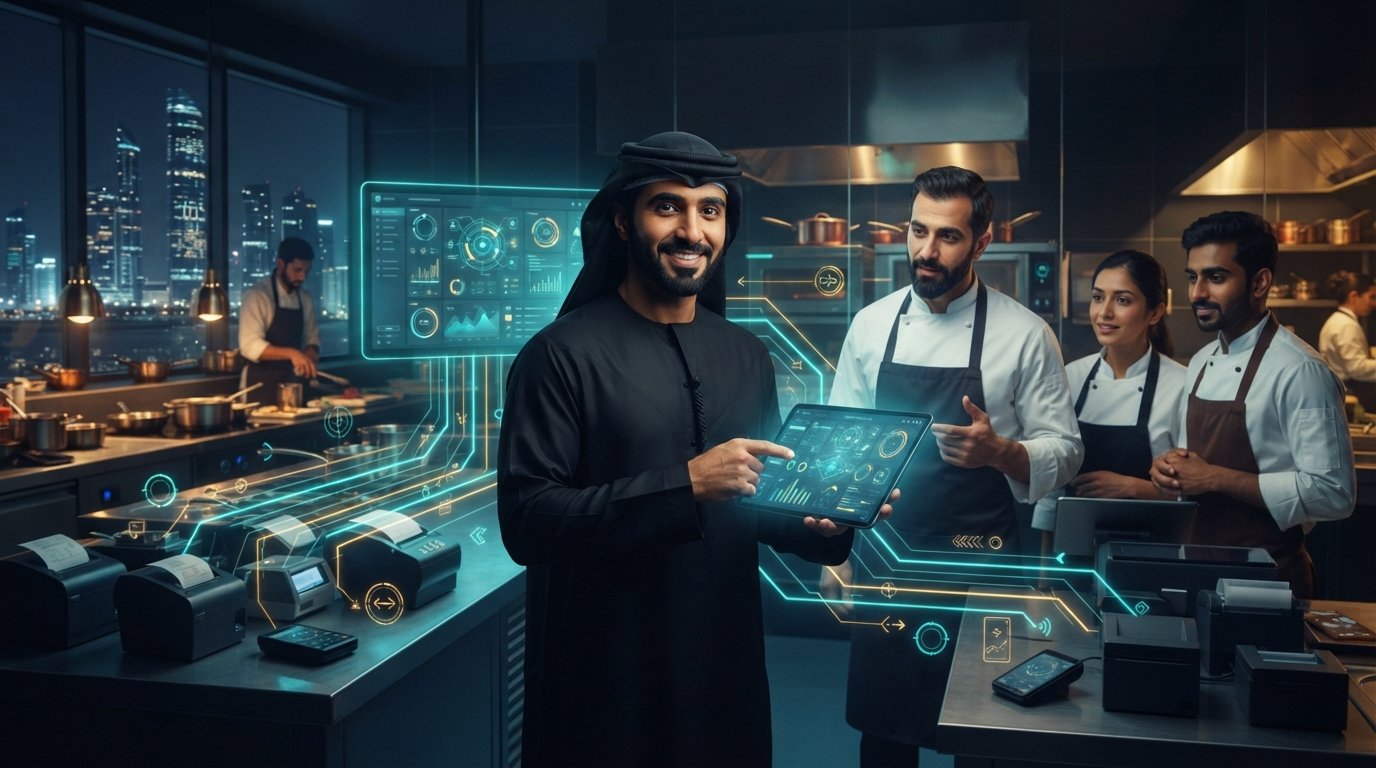
Restaurant Technology ROI Calculator: The 2026 UAE Growth Framework
Did you know that UAE kitchens running unintegrated aggregator tablets lose up to 8% of their digital order volume simply because of manual entry lag and missed notifications? If you're managing a venue in Dubai or Abu Dhabi, you've likely felt the sting of tablet hell where staff spend ten hours a week re-keying orders while aggregator commissions eat up to 35% of your margins. It's frustrating to watch your hard-earned revenue vanish into operational friction instead of fueling your growth.
This guide provides a definitive restaurant technology ROI calculator framework tailored for the 2026 UAE market, showing you exactly how to reclaim that lost revenue through structural automation. We'll break down a five-step financial framework to monetize saved labor, eliminate order errors, and transition your guests toward high-margin direct sales. You'll learn how to replace fragmented chaos with a unified digital infrastructure that protects your bottom line and empowers your team to focus on hospitality again.
Key Takeaways
- Eliminate the "tablet tax" by automating order flow, reclaiming over 10 hours of staff time per week previously lost to manual re-entry.
- Use our structured restaurant technology ROI calculator framework to quantify the exact dollar value of reduced kitchen errors and recaptured labor costs.
- Protect your margins from 35% aggregator commissions by shifting delivery traffic to a branded White-Label Mobile App for direct sales.
- Achieve a "zero-tablet" kitchen using Universal Bridge middleware to sync all aggregator and direct orders into one unified POS terminal.
- Prepare your business for 2026 growth by integrating tech that aligns with the UAE's mandatory digital e-invoicing and tax compliance standards.
Beyond the Tablet: The Hidden Costs of Fragmented UAE Restaurant Operations
UAE restaurant operators often view technology as a line-item expense rather than a structural asset. This perspective hides the "Tablet Tax," a silent drain where fragmented systems pull staff away from guests to manage a wall of buzzing hardware. In high-volume markets like Dubai, managing separate terminals for Talabat, Deliveroo, and Careem creates a state of operational chaos. This isn't just an inconvenience; it's a structural failure that prevents you from optimizing your menu across different branches. When data lives in silos, you can't see which dishes are underperforming in Sharjah versus Abu Dhabi in real-time.
Staff retention also suffers in this environment. High-performing servers don't want to work as data entry clerks. They want to provide hospitality. To understand the true impact, you need a robust restaurant technology ROI calculator that accounts for these invisible overheads. Using a standard return on investment (ROI) calculation helps, but it must be tailored to the specific friction of the UAE's multi-aggregator ecosystem to be accurate.
The Labor Cost of Manual Entry
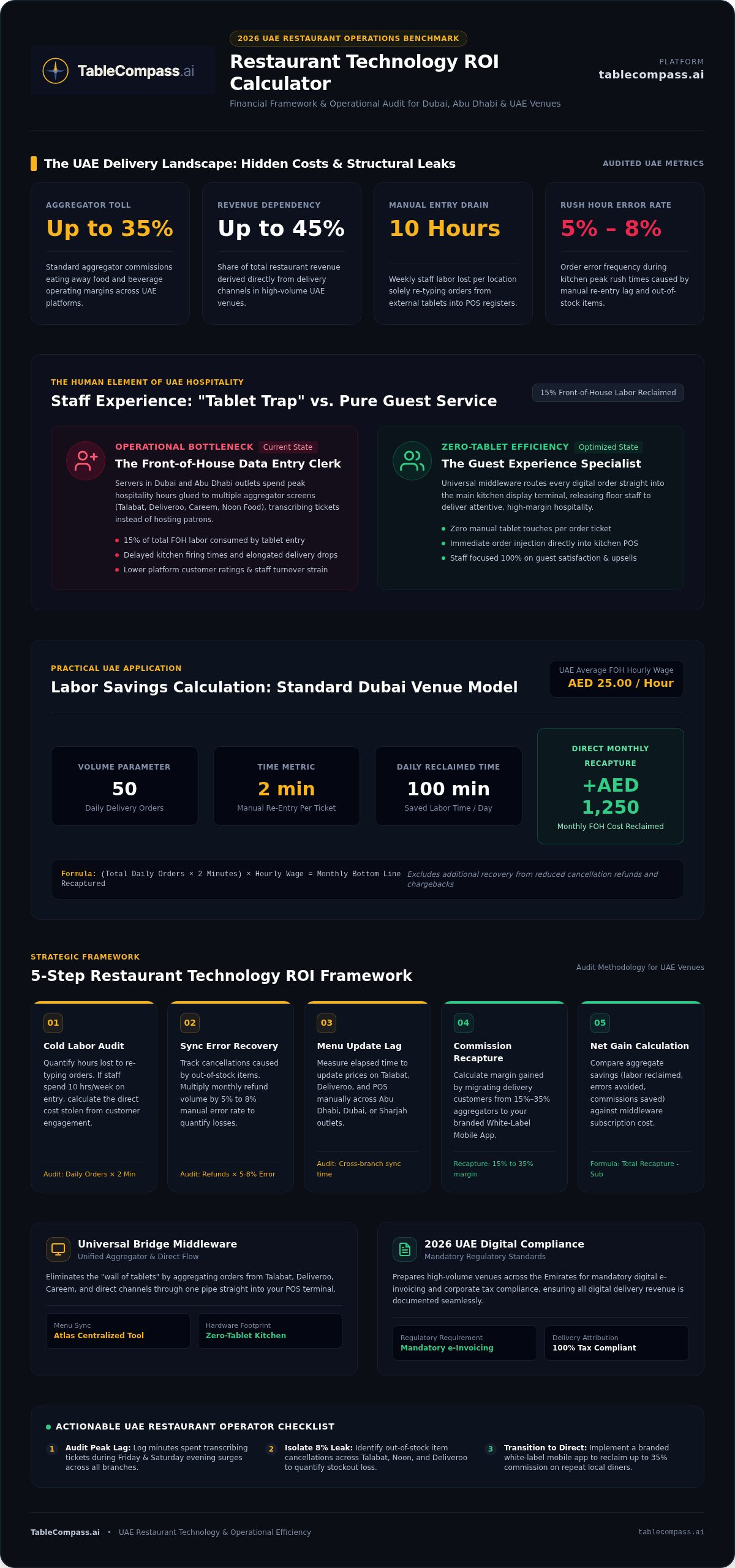
Staff spend an average of 10 hours per week per location simply re-typing orders from aggregator tablets into the POS. During peak hours, this creates a bottleneck that delays kitchen firing times and drives up delivery durations. These delays lead to lower platform ratings, which directly impacts your visibility on apps like Noon Food. The Manual Entry Drain accounts for roughly 15% of total front-of-house labor costs when managing multiple unintegrated delivery platforms.
Revenue Leakage from Order Errors
A cancelled order costs far more than the ingredients. You lose the food cost, the labor spent preparing it, and the potential lifetime value of that customer. In the UAE, where delivery accounts for up to 45% of revenue, these errors are catastrophic. If your inventory isn't synced, you'll inevitably sell "Out of Stock" items, leading to forced cancellations and platform penalties. Many operators believe their staff can handle the tablets, but the data-driven reality is that human entry during a rush has a 5% to 8% error rate. Integrated systems eliminate this risk entirely, turning missed opportunities back into net profit.
Calculating the Real ROI: A 5-Step Financial Framework for 2026
To move from operational stress to technological mastery, you need a precise restaurant technology ROI calculator. This framework isn't about guesswork; it's about auditing the internal mechanics of your kitchen to identify where capital is leaking. A recent National Restaurant Association technology investment survey shows that over 75% of operators now leverage integrated tools to protect their margins. In the UAE, where delivery volume accounts for nearly half of total revenue, this structural shift is no longer optional.
Step 1 requires a cold audit of labor. If your staff spends 10 hours a week re-entering orders, that's time stolen from guest engagement. Step 2 focuses on recovery by tracking every cancellation caused by a "menu sync" error. Step 3 measures "Menu Update Lag," the time it takes to change a price on Talabat versus your POS. Step 4 factors in the recovery of the 15% to 35% aggregator commission through direct apps. Finally, Step 5 compares these total savings against the subscription cost of your middleware to reveal your net gain.
Step-by-Step ROI Calculation Logic
To calculate Labor Savings, use this formula: (Total daily orders x 2 minutes) x Hourly Wage. For a standard Dubai outlet with an average hourly front-of-house wage of AED 25 in 2026, saving just two minutes per order across 50 daily orders adds AED 1,250 back to your monthly bottom line. Error Reduction is equally vital. Multiply your Monthly Refund Value by your Error Percentage, which typically sits between 5% and 8% for manual entry, to see the immediate recovery potential. These numbers prove that automation pays for itself by plugging the holes in your existing operation.
Factoring in the 'Atlas' Advantage
Manual menu updates are a structural weakness that drains administrative time. Centralized menu management restaurants UAE use Atlas to sync availability instantly across all digital storefronts. This eliminates the "Out of Stock" cancellations that plague unintegrated venues and damage your platform rankings. By centralizing your inventory engine, you ensure that every aggregator reflects the reality of your kitchen pass. This synchronization is the foundation of a high-performance operation. If you're ready to stop the revenue leakage, explore how TableCompass.ai can unify your tech stack into a single, high-speed engine.
Aggregator Commissions vs. Direct Ordering: A Profit Margin Comparison
In the UAE's high-velocity dining market, aggregators act as powerful gateways but demand a heavy toll. Many operators realize too late that they're effectively working for the platforms rather than themselves. A 30% commission on a standard order often wipes out the net profit entirely once you account for food costs, packaging, and labor. Breaking this dependency is the most significant lever in your restaurant technology ROI calculator. While platforms like Talabat and Deliveroo provide reach, they also command between 25% and 35% of every transaction. When you factor in the ad spend required to stay visible on their homepages, your net margin often shrinks to single digits.
The long-term value of your business depends on customer data ownership. When a guest orders through an aggregator, you don't own the relationship; the platform does. Shifting just 15% to 20% of that traffic to your own White-Label Mobile App can retain between AED 54,000 and AED 90,000 in annual net margin per outlet. This isn't just about saving fees. It's about building a direct, high-performance channel where you control the guest experience and the data that drives it.
The True Cost of a Delivery Order
The "hidden" margin killer is the combination of aggregator fees, delivery surcharges, and internal marketing spend. To see the structural difference, compare the net profit of a standard AED 100 order. On an aggregator, your take-home pay is crippled by a "stack" of deductions. On a branded app, you bypass the commission entirely, leaving significantly more capital to reinvest in your growth.
| Metric | Aggregator Order | White-Label App Order |
|---|---|---|
| Order Value | AED 100 | AED 100 |
| Commission Fee (Avg 30%) | AED 30 | AED 0 |
| Marketing/Ad Spend | AED 5 | AED 0 (Direct) |
| Net Margin Contribution | AED 65 (Before COGS) | AED 100 (Before COGS) |
Automating Loyalty with GuestConnect AI
GuestConnect AI serves as the structural bridge for this transition. It automates engagement, ensuring that every direct customer feels recognized without requiring a dedicated marketing manager. This AI guest engagement restaurant software handles everything from review automation to personalized loyalty campaigns. It turns one-time delivery users into high-value direct patrons, significantly lowering your customer acquisition costs. By automating these touchpoints, you increase repeat orders without adding to your staff's workload, creating a self-sustaining engine for profitability.
Strategic Implementation: Transitioning from Manual Chaos to Integrated Order Flow
The shift from manual chaos to a unified digital architecture requires a strategic roadmap. You've used the restaurant technology ROI calculator to identify your financial leaks; now you must plug them. Achieving a "Zero-Tablet" kitchen isn't just about aesthetics. It's about removing the physical barriers between your staff and your guests. For restaurant groups in Dubai and Abu Dhabi, this means consolidating every aggregator stream into a single kitchen display system (KDS). This structural unity allows your chefs to focus on the pass rather than juggling six different buzzing devices.
Universal Bridge acts as the structural foundation for this transition. It simplifies POS integration by acting as a translator between different software languages, ensuring your existing hardware communicates perfectly with new automation modules. Managers should focus on training their teams to trust the automation. Start by explaining how this tech gives them back their time to focus on hospitality. Phased rollouts are the safest path for multi-location brands. Launching in one high-volume branch allows you to refine the workflow before scaling across the Emirates.
Building the Tech Backbone
Reliable synchronization is the lifeblood of your operation. Middleware like OmniSync acts as the essential "glue" that binds your POS to aggregators. It ensures 99.9% uptime, which is critical during high-pressure weekend rushes in Downtown Dubai. Beyond order flow, your backbone must support the UAE Federal Tax Authority's shift toward mandatory digital e-invoicing. Integrated platforms that support the PINT AE format ensure you stay compliant as the 2027 enforcement milestones approach. You can find more details in our POS middleware hospitality UAE integration guide.
Optimising the Digital Workflow
Automation extends to the dining floor through QR Table Ordering & Pay. This technology increases table turnover by allowing guests to settle their bills instantly, reducing the pressure on your floor staff during peak hours. You also gain access to real-time reporting that drives 2026 business decisions. Use this data to identify which menu items have the highest net margin after accounting for labor and prep time. Actionable tip: Start with your busiest branch to prove the ROI, then use those results to motivate your entire organization. To begin your transition to a high-performance integrated flow, book a strategy session with TableCompass.ai today.
TableCompass.ai: The Structural Engine for High-Performance UAE F&B
TableCompass.ai serves as the silent partner driving the most efficient kitchens in the Emirates. It's more than a collection of software modules; it's the essential infrastructure that empowers your business to scale with surgical precision. By integrating our suite, you move beyond the theoretical figures of a restaurant technology ROI calculator and begin to realize actual margin expansion across every channel. Our technology replaces operational friction with a sense of mastery, giving you total control over the internal mechanics of your restaurant group.
OmniSync functions as the primary bridge between your POS and the UAE's major aggregators. It automates the flow of data, ensuring that every order from Talabat or Deliveroo lands directly in your kitchen without human intervention. To complement this, Atlas Menu Management provides the architecture for centralized control. It allows you to sync menu availability and inventory levels instantly, preventing the costly cancellations that damage your reputation. GuestConnect AI completes the ecosystem by transforming every interaction into measurable revenue, using automated engagement to drive repeat business without adding to your payroll.
Why TableCompass is the Insider's Choice
UAE leaders choose TableCompass because we aren't a generic global provider; we're a high-performance partner deeply rooted in the local hospitality ecosystem. We understand the specific pressure points of the Dubai and Abu Dhabi markets. Our deep integration with regional platforms ensures that your tech stack remains rock-solid during the most demanding shifts. We act as visionary architects for your business, providing the tools to replace fragmented chaos with integrated order. This local specialization allows us to offer support that truly understands the rhythm of your operations.
Next Steps for Your ROI Journey
The transition from manual labor to technological mastery starts with a clear understanding of your current performance. We recommend requesting a custom ROI audit for your restaurant group to see exactly where your capital is leaking. Our team will help you map out a roadmap for implementation, ensuring that your transition to an automated workflow is smooth and successful. You can see the technology in action by booking a demo of our full suite of tools. Don't let another month of commission fees and manual errors drain your profitability. Calculate your potential savings with TableCompass.ai and start building your growth framework today.
Architecting Your Expansion in the 2026 UAE Market
The transition from operational chaos to technological mastery is no longer a choice for UAE restaurant groups; it's a structural necessity. By applying the restaurant technology ROI calculator framework, you've identified the specific friction points where your capital is leaking into manual re-entry and unmanaged aggregator commissions. Reclaiming those margins requires a unified digital backbone that connects every terminal and digital storefront into a single, high-performance engine.
TableCompass.ai provides the essential infrastructure to fuel this growth. Through OmniSync and Universal Bridge middleware, you eliminate the "tablet tax" while Atlas Menu Management ensures total synchronization across your entire branch network. Our AI suite and local UAE support team give you the insider's edge to drive direct sales and guest loyalty. It's time to replace operational stress with a vision of integrated order and scalable success.
Ready to see the exact impact on your bottom line? Request Your Custom ROI Audit from TableCompass.ai and discover how our structural engine can empower your restaurant to thrive.
Frequently Asked Questions
How do I calculate the ROI of restaurant technology?
You calculate the return by dividing your net gain from technology by the total cost of the investment. A standard restaurant technology ROI calculator focuses on three structural pillars: labor hours reclaimed from manual entry, revenue recovered from eliminated order errors, and profit margins saved by shifting aggregator orders to direct channels. In the UAE's high-cost labor market, even saving two minutes per order creates a significant annual financial impact for your restaurant group.
What is the average ROI for POS middleware in the UAE?
While individual results vary based on order volume, most UAE operators see a return within the first quarter of implementation. POS middleware like OmniSync eliminates the need for dedicated order-entry staff during peak rushes in Dubai and Abu Dhabi. By centralizing operations, you reduce the "tablet tax" and reclaim up to 10 hours of staff time weekly. This structural efficiency allows your team to focus on hospitality while the technology handles the heavy lifting.
How much can I save by integrating Talabat with my POS system?
Integrating Talabat with your POS via OmniSync allows you to recover up to 8% of digital order volume previously lost to manual entry lag. You also eliminate the 15% of labor costs typically spent on re-keying orders. This synchronization prevents the costly "Out of Stock" cancellations that damage your platform ranking. By automating this bridge, you ensure every dirham spent on aggregator marketing actually results in a fulfilled, error-free order.
What are the hidden costs of manual order entry for restaurants?
The hidden costs include staff burnout from "tablet hell," kitchen misfires due to manual entry errors, and platform penalties for slow order acceptance. In high-volume UAE environments, unintegrated tablets lead to a 5% to 8% error rate during evening rushes. These mistakes don't just cost you the meal; they erode customer lifetime value and lower your visibility on aggregators like Deliveroo and Careem, creating a long-term revenue drain.
How does a branded mobile app improve restaurant profit margins?
A branded White-Label Mobile App improves margins by bypassing the 15% to 35% commission fees charged by third-party aggregators. It allows you to retain 100% of the order value while building a direct database of your UAE customers. This data ownership is vital for launching targeted marketing campaigns without paying for platform ads. Direct ordering channels typically retain AED 54,000 to AED 90,000 in annual margin per outlet compared to aggregator-heavy models.
Can AI guest engagement tools really drive measurable revenue?
Yes, GuestConnect AI drives revenue by automating the engagement cycle that humans often miss during busy shifts. It handles review management and personalized loyalty rewards to turn one-time delivery users into repeat direct patrons. In the competitive Dubai dining scene, this automation ensures your brand stays top-of-mind. By increasing repeat order frequency without adding to your headcount, AI tools provide a measurable boost to your net profit margins.
Is it worth investing in QR code ordering for fine dining restaurants?
QR Table Ordering & Pay is highly effective for fine dining because it empowers guests to settle their bills instantly, increasing table turnover. It doesn't replace high-end service; it removes the administrative friction of waiting for a machine. Your staff can spend more time on table-side storytelling and less time processing transactions. This technology also captures valuable guest data that allows for personalized follow-ups, which is essential for maintaining luxury hospitality standards.
How long does it take to see a return on investment from TableCompass.ai?
Most venues using the TableCompass.ai suite experience operational relief on day one and a full financial return within three to six months. The immediate elimination of manual order entry and reduction in kitchen errors provide instant cost recovery. As you leverage the restaurant technology ROI calculator to shift traffic toward your White-Label Mobile App, the commission savings accelerate your net gain. Our local UAE support ensures your system is optimized for maximum performance from the start.