
Restaurant Inventory Synchronization Tools: The 2026 Guide to Real-Time Stock Control
Periodic stock counts don't protect kitchen margins; they merely document money you've already lost. If your team still manually reconciles POS tickets with spreadsheets while orders flood in from Talabat and Deliveroo, you know the chaos firsthand. A line cook runs out of prep during a weekend rush, an out-of-stock dish sells on three delivery apps at once, and staff scramble to issue refunds. Deploying modern restaurant inventory synchronization tools transforms stock control from a reactive guessing game into an active engine for revenue protection.
You already know that end-of-week counts can't keep pace with fast-moving, multi-channel kitchens across the UAE. This comprehensive 2026 guide reveals how real-time synchronization connects your POS terminals and delivery channels to eliminate stockouts, cut costly food waste, and safeguard your margins. Here is everything you need to know about automated 86ing, dynamic ingredient-level depletion, and practical inventory workflows designed to give your kitchen complete operational control.
Key Takeaways
- Connect your front-of-house orders directly to kitchen stock registers through automated recipe mapping that depletes ingredients to the gram.
- Protect high-volume UAE operations from unfulfillable orders by establishing dynamic buffer pars tailored for regional aggregator demand and supplier lead times.
- Evaluate restaurant inventory synchronization tools based on bidirectional capabilities that instantly 86 depleted menu items across all digital storefronts.
- Standardize master ingredient catalogs and sub-recipe units of measure across every branch to eliminate cost variance between kitchen shifts.
- Unify your POS systems and delivery channels using dedicated integration middleware like TableCompass OmniSync and Atlas Menu Management for total operational control.
What Are Restaurant Inventory Synchronization Tools and How Do They Work?
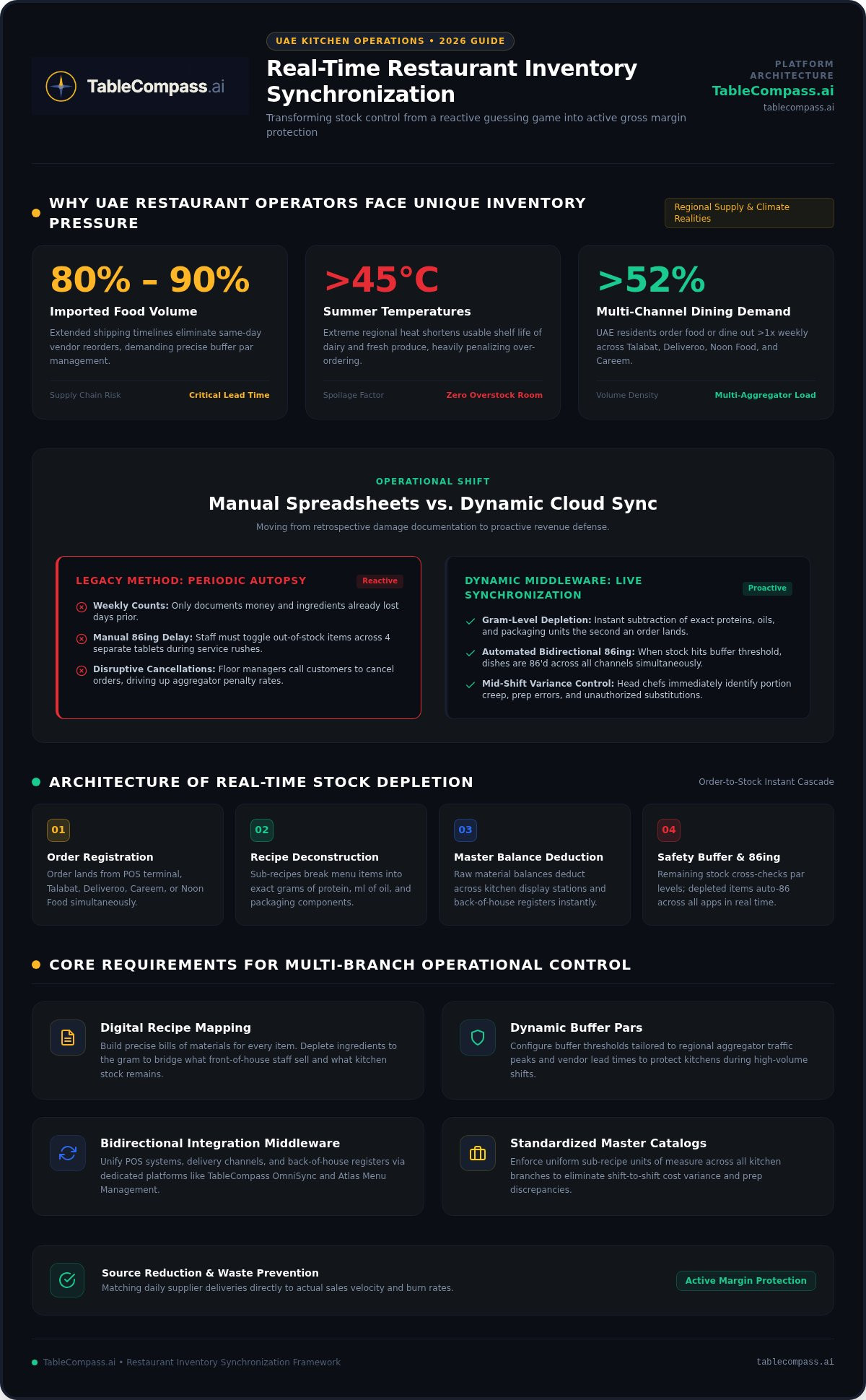
Most legacy hospitality platforms treat inventory as a passive ledger. Modern restaurant inventory synchronization tools operate as active operational middleware, building an unbroken bridge between front-of-house sales channels and back-of-house stock registers. Instead of logging ingredients after a shift ends, this software tracks stock consumption the exact second an order enters the kitchen workflow.
The mechanics rely on digital recipe mapping. Every menu item breaks down into a structured bill of materials: exact grams of protein, milliliters of oil, and discrete packaging units. When a guest orders a dish, the system automatically decrements those component ingredients from master inventory levels across all kitchen stations, eliminating the disconnect between what floor staff sell and what kitchen stock remains.
The Architecture of Real-Time Stock Depletion
Real-time synchronization operates on an event-driven framework rather than delayed batch updates. The moment an order registers at the cashier station or pings from a digital channel, the platform triggers an immediate cascade:
- It deconstructs the ordered menu item into individual raw ingredients according to pre-configured sub-recipes.
- It deducts raw material balances across all connected operational displays instantly.
- It cross-checks remaining stock against safety buffer levels to protect the kitchen line during high-volume service.
By executing live deductions rather than waiting for end-of-day batches, kitchen teams avoid the costly delays that lead to unfulfillable tickets and scrambled prep stations.
Static Spreadsheets vs. Dynamic Cloud Synchronization
Relying on manual spreadsheets turns stock control into an autopsy. Weekly physical counts only reveal what vanished days ago; they leave managers blind to mid-shift prep waste, unrecorded spills, and gradual shrinkage. Modern cloud inventory management software replaces that retrospective guesswork with continuous visibility.
Dynamic cloud platforms maintain a living calculation of theoretical inventory against actual stock on hand. When head chefs and supervisors monitor live variances rather than waiting for Sunday night audits, they identify portion creep, prep errors, and unauthorized substitutions immediately. This visibility turns restaurant inventory synchronization tools into vital revenue guards that protect daily gross margins across every service.
Why UAE Restaurant Operators Face Unique Inventory Challenges
Operating a kitchen in the United Arab Emirates presents structural hurdles rarely found in traditional hospitality markets. Between 80% and 90% of food consumed across the country is imported, turning standard procurement into an operational tightrope. Extended supplier shipping timelines mean kitchens can't rely on same-day vendor reorders when stock runs low. At the same time, regional summer temperatures exceeding 45°C shorten the usable shelf life of sensitive fresh produce and dairy, severely punishing over-ordering.
Balancing tight buffer stocks with zero-stockout tolerances requires clinical precision. Implementing dedicated restaurant inventory synchronization tools allows kitchen managers to monitor actual burn rates in real time, preventing food waste through source reduction by matching daily deliveries directly to true sales velocity.
Managing High Aggregator Volumes Across Talabat, Deliveroo, and Careem
Delivery platforms drive massive revenue for UAE operators, with over 52% of residents ordering food or dining out more than once a week. Yet managing simultaneous tickets from Talabat, Deliveroo, Noon Food, and Careem across separate counter tablets creates immense operational friction. When a kitchen line exhausts an ingredient during a Friday evening peak, manually toggling items off across four different merchant dashboards takes too long.
Seconds of delay lead to disastrous chain reactions:
- Unfulfillable tickets flood the pass, forcing floor supervisors to call customers and cancel orders manually.
- Aggregator cancellation rates climb, which triggers algorithmic ranking penalties and drops the restaurant down in local app feeds.
- Delivery drivers congregate at the counter, clogging front-of-house workflow while kitchens scramble to issue refunds.
Cross-Branch Transfers and Central Kitchen Logistics in the Emirates
Scaling across Dubai, Abu Dhabi, and Sharjah increasingly demands a hub-and-spoke model. Central production facilities prep bulk proteins, sauces, and dough bases, then dispatch daily requisitions to satellite branches and cloud units. When internal transfer orders aren't tracked digitally to the gram, inventory variances compound across locations.
A commissary might log a 20-kilogram transfer of marinated beef, but if receiving branch staff log it simply as "three bins," portion control collapses. Combining digital transfer logging with First-Expired, First-Out stock rotation protects cold-chain integrity across transit. Modern restaurant inventory synchronization tools align regional commissary dispatches with branch depletion levels, ensuring every outlet maintains precise par buffers without holding surplus perishable stock in high-risk climates.
Core Features to Evaluate in Restaurant Inventory Synchronization Software
Selecting software for high-output hospitality operations requires looking past generic spreadsheets and basic ERP checklists. When evaluating restaurant inventory synchronization tools, focus on operational architecture. The right software acts as an active central nervous system, connecting your front-of-house service counters, back-of-house stock rooms, and digital aggregators into an integrated operational engine.
Industry leaders prioritize software designed to automate manual tasks while maintaining strict accuracy. Following best practices for implementing an inventory management system, operators must audit platforms based on three essential functional capabilities: two-way data connectivity, automated menu guardrails, and granular variance tracking.
Bidirectional POS and Delivery Aggregator Integration
One-way data pipelines create operational friction. If sales data flows from aggregator terminals to your kitchen printer without updating central stock registers, counts drift immediately. True synchronization demands bidirectional middleware. When an order fires from Talabat, Noon Food, or a table QR code, the software must decrement ingredient batches instantly while returning confirmed stock availability back to the ordering channel.
Deploying seamless restaurant POS synchronization eliminates double-entry mistakes. Cashiers stop manually re-keying aggregator tickets into the main terminal, cutting order entry errors and keeping kitchen prep screens unified.
Automated Item 86ing Across All Digital Menus
Manual menu updates fail during peak dining rushes. High-performing synchronization tools allow operators to set strict safety thresholds for vital raw ingredients. When the last portions of wagyu beef, halloumi, or burger buns are claimed, the software triggers an instant, automated 86 command across all sales endpoints simultaneously.
Pairing your inventory platform with centralized menu management restaurants UAE protects customer trust and staff sanity. Line cooks don't have to pause service to track down a floor manager, and front-of-house teams never face frustrated delivery riders waiting for canceled orders.
Recipe Costing and Variance Analytics
Live inventory control transforms financial reporting by highlighting operational leakages as they occur. Robust platforms cross-reference physical ingredient counts against theoretical recipe consumption, exposing hidden margins loss across kitchen stations:
- Portion drift: Identifies stations where line staff consistently over-portion high-cost proteins and cheeses.
- Procurement price spikes: Flags sudden vendor cost jumps across imported goods so chefs can adjust dish pricing or swap suppliers.
- Waste isolation: Categorizes prep trimming, burnt tickets, and unrecorded spoilage directly on kitchen tablets.
Continuous variance visibility turns restaurant inventory synchronization tools into daily profit engines, keeping prime food costs firmly within targeted margins.
Step-by-Step Implementation: Syncing Inventory Across Your Tech Stack
Transitioning to active synchronization requires methodical setup. Software is only as dependable as the database beneath it. To deploy restaurant inventory synchronization tools effectively across your UAE outlets, follow a structured rollout that aligns your digital catalog, kitchen operations, and integration bridges before flipping the switch on live shifts.
Cleaning and Standardizing Master Ingredient Data
Faulty master data breaks automated deductions. Start by consolidating fragmented supplier spreadsheets into a single, clean ingredient ledger. If your POS lists an item as "Chicken Breast 2.5kg" while your central commissary logs it as "Fresh Poultry Fillet (Kg)", automatic depletion fails.
Standardize bulk packaging into standard culinary units, breaking delivery crates down into single grams or milliliters. Assign unique stock-keeping codes across all branches. Whether an ingredient is received at a prep kitchen in Al Quoz or prepped in Abu Dhabi, the system must track it under one uniform identity.
Deploying Middleware for Unified Channel Synchronization
Once your database is standardized, integrate your sales channels. Utilize dedicated POS middleware hospitality UAE operators rely on to bridge physical registers with Talabat, Deliveroo, and Noon Food.
Map each aggregator item code directly to its corresponding recipe bill of materials. Establish minimum safety stock thresholds for critical proteins and imported dairy. Conduct a dual-run trial during a quiet weekday lunch service, firing test orders through each channel to verify that ingredient balances deduct accurately to the single gram.
Staff Training and Operational Wastage Protocols
Technology succeeds only when line staff adopt it. In UAE kitchens staffed by diverse, multilingual teams, software interfaces must be intuitive and visual. Give prep cooks tablet-based waste stations where they can record burnt items, trim losses, or dropped prep with two taps.
Institute a five-minute closing count focused exclusively on high-cost key items like tenderloins, seafood, and specialty cheeses. If you want to eliminate manual reconciliation headaches and establish total stock control, integrate TableCompass.ai into your kitchen workflow to unite your multi-channel operations today.
How TableCompass OmniSync Powers Cohesive F&B Operations
Fragile operational setups rely on piecemeal plugins and disconnected tablets. TableCompass OmniSync operates as an architectural foundation for UAE hospitality brands, elevating standard restaurant inventory synchronization tools into a unified operational engine. By serving as dedicated middleware that connects point-of-sale registers, back-of-house storage, and digital sales portals, OmniSync works alongside Atlas Menu Management to give operators complete command over digital catalogs, live stock balances, and menu availability.
Eliminating Blind Spots with OmniSync Middleware
When sales registers operate in silos, kitchen visibility dissolves. OmniSync captures every transaction, whether punched by a floor server, ordered through a table QR code, or dispatched via Talabat, and routes it directly to your central stock ledger without delay. This eliminates the manual ticket re-keying that bogs down front-of-house teams and introduces human error into stock counts.
Adopting a dedicated restaurant aggregator integration solution ensures that stock depletion mirrors physical reality. When Atlas Menu Management coordinates with OmniSync, a sold-out dessert or depleted cut of protein automatically deactivates across all connected channels simultaneously, saving your brand from order rejections, delivery portal penalties, and disappointed diners.
Future-Ready Kitchen Operations for Growing Hospitality Groups
Expanding an F&B brand across Dubai, Abu Dhabi, or Sharjah shouldn't require bloating your administrative payroll. As hospitality groups launch new virtual brands or open satellite locations, modern restaurant inventory synchronization tools scale alongside them. OmniSync standardizes ingredient deductions across diverse concepts sharing a single prep line, providing corporate chefs and operations directors with unified margin reporting across every kitchen station.
Kitchen teams regain their focus. Instead of logging hours comparing POS reports against paper prep sheets, managers can dedicate their energy to food quality, speed of service, and guest hospitality. Explore how TableCompass.ai coordinates your digital ecosystem to give your team effortless stock accuracy and total operational control.
Transform Your Inventory Into Active Revenue Protection
Manual spreadsheets and disconnected aggregator tablets have no place in a high-performing UAE restaurant group. Implementing dedicated restaurant inventory synchronization tools turns stock control from a post-service postmortem into an active defense system for your bottom line. When every ticket automatically depletes raw ingredients down to the gram and out-of-stock items 86 across Talabat, Deliveroo, and Noon Food in seconds, your kitchen runs with relentless precision.
You don't have to let manual order re-entry, tablet clutter, and inventory variance drain your kitchen's profits. Connect your POS and aggregators with TableCompass OmniSync to harness native bidirectional synchronization designed specifically for UAE operators. Paired with centralized catalog control through Atlas Menu Management, you give your team the infrastructure they need to scale confidently, cut food waste, and deliver exceptional dining experiences every shift.
Frequently Asked Questions
How do restaurant inventory synchronization tools handle recipe modifications and custom orders?
Advanced restaurant inventory synchronization tools parse line-item modifiers directly from POS checks or online ordering apps. If a diner requests extra protein, swaps sides, or asks for no sauce, the system adjusts the underlying bill of materials dynamically. It decrements the added ingredients and retains untouched ones, maintaining accurate theoretical depletion right down to custom guest requests.
Can inventory synchronization software automatically 86 items on Talabat and Deliveroo?
Yes, modern synchronization middleware automates this entirely. When a key ingredient hits zero or drops below your minimum buffer threshold, the system sends an instant deactivation command across connected aggregators like Talabat, Deliveroo, and Noon Food via direct APIs. Kitchen teams don't have to scramble across separate tablets during rush hours, preventing unfulfillable tickets and aggregator cancellation penalties.
What is the difference between an inventory management system and inventory synchronization middleware?
A traditional inventory management system acts as a static repository for logging stock counts, purchase orders, and supplier invoices. Synchronization middleware, such as TableCompass OmniSync, functions as the real-time connective tissue. It links front-of-house POS registers and multi-channel delivery portals directly to your stock registers, ensuring live order data depletes inventory instantly across every sales touchpoint without manual data re-entry.
How long does it take to implement automated inventory synchronization across multiple restaurant sites?
Rollout timelines depend on the cleanliness of your master ingredient data. Most UAE restaurant groups complete deployment across multiple branches within two to four weeks. The process involves auditing ingredient units of measure, mapping digital sub-recipes, and connecting existing POS terminals through middleware. Testing begins during low-volume shifts, allowing kitchen teams to calibrate live deductions before going live across all shifts.
Will our restaurant need to replace existing POS terminals to synchronize inventory?
No, you don't need to replace your existing POS hardware or core terminals. Cloud-based middleware like TableCompass Universal Bridge connects directly with leading hospitality POS systems and delivery aggregators. It operates as an intelligent integration layer in the background, capturing order streams and synchronizing stock levels without forcing operators into costly hardware replacements or disruptive workflow overhauls.
How does automated stock synchronization reduce food waste and lower cost of goods sold?
Deploying restaurant inventory synchronization tools provides continuous visibility into theoretical versus actual ingredient consumption. Instead of waiting for weekly audits, chefs spot portion drift, unrecorded prep spills, and spoilage instantly. Tying live sales velocity to procurement ensures kitchens don't over-order sensitive perishables in hot regional climates, directly lowering cost of goods sold and supporting UAE national food waste reduction targets.
Can inventory synchronization tools manage raw material transfers between a central prep kitchen and branches?
Yes, comprehensive synchronization platforms coordinate hub-and-spoke production models seamlessly. Central commissaries can dispatch batch requisitions, while receiving satellite units log transfers digitally on station tablets. The software instantly decrements raw stock from the central facility and credits the branch inventory register to the exact gram, maintaining strict portion accountability and preventing missing stock between inter-emirate transit routes.