Multi Channel Menu Management: 2026 UAE Restaurant Guide
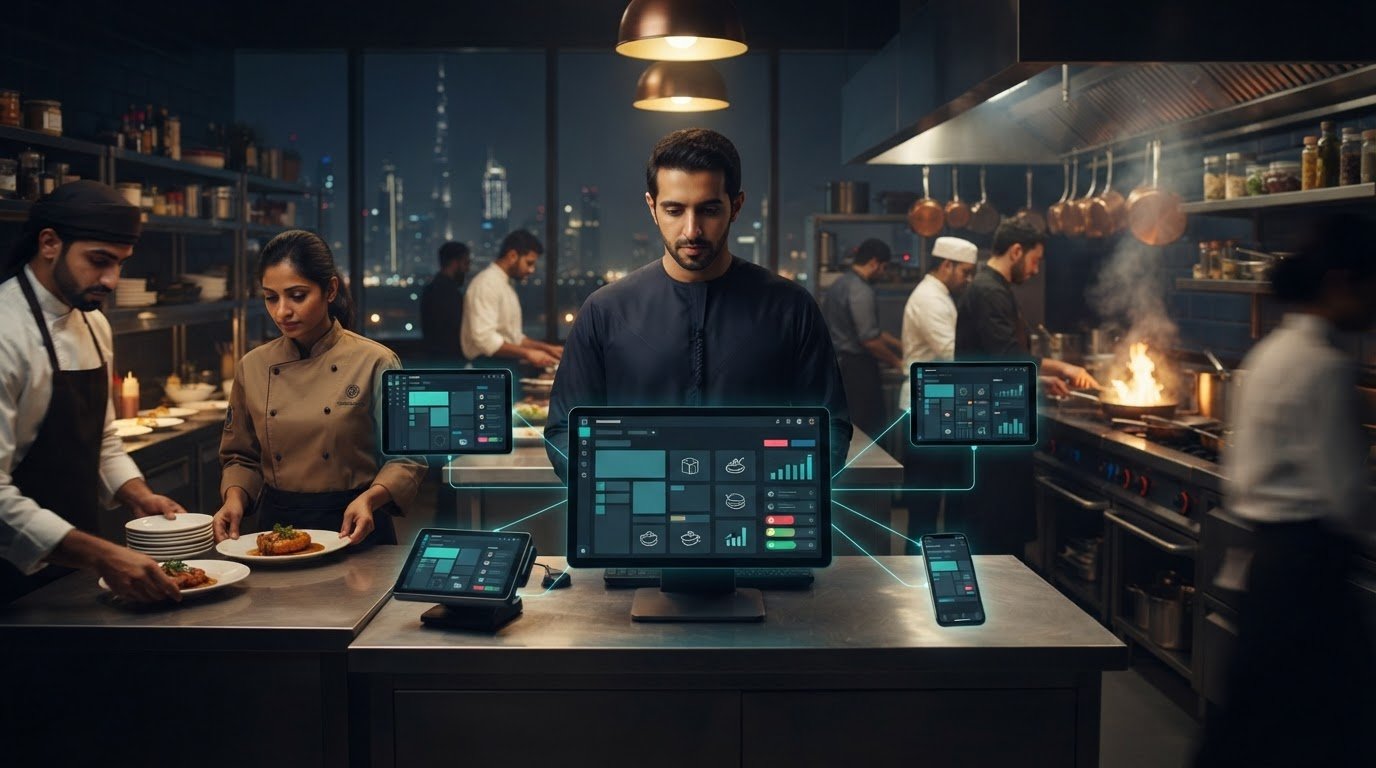
A row of five flashing delivery tablets at the expeditor station isn't proof of a thriving restaurant; it is a clear sign your kitchen is losing control. During an 8:30 PM dinner rush in Dubai or Abu Dhabi, manual order re-entry across Talabat, Deliveroo, and Noon creates catastrophic ticket delays, customer complaints, and costly aggregator penalties. Every discrepancy between your point of sale and your third-party storefronts drains revenue. Without robust multi channel menu management acting as your operational nerve center, fragmented digital channels will quietly erode your hard-earned margins.
You shouldn't have to scramble across separate dashboards just to update pricing or 86 a sold-out ingredient. This guide shows you how to master multi channel menu management across delivery aggregators, POS systems, and direct ordering to eliminate entry errors and protect your bottom line. We'll break down how centralized menu architecture, instant synchronization, and single-click catalog updates keep UAE kitchens fully aligned, compliant, and consistently profitable.
Key Takeaways
- Eliminate front-counter tablet clutter by routing all delivery orders directly into your existing POS system.
- Deploy centralized multi channel menu management to push live pricing, item photos, and descriptions across Talabat, Deliveroo, and Noon simultaneously.
- Prevent costly order cancellations by setting up instant 86ing triggers that sync out-of-stock items across every digital channel in seconds.
- Standardize modifier groups and pricing structures using a proven five-step audit to stop aggregator commission bleed.
- Connect legacy kitchen terminals to modern cloud channels with specialized middleware like Atlas Menu Management and OmniSync.
What Is Multi Channel Menu Management in Modern Restaurant Operations?
Multi channel menu management is the centralized process of synchronizing dishes, modifier groups, dynamic pricing, and stock availability across every sales channel from a single master database. When food delivery expanded rapidly across Dubai and Abu Dhabi, most operators scrambled to onboard with aggregators individually. This created isolated silos where menus drifted apart, leaving kitchens with mismatched tickets and frustrated guests.
Instead of managing fragmented digital storefronts, modern operators link their central point-of-sale (POS) system directly to third-party marketplaces, proprietary apps, and table QR ordering tools. This operational pipeline ensures every update made at head office instantly reflects across the entire brand footprint.
The Core Components of an Omnichannel Restaurant Menu
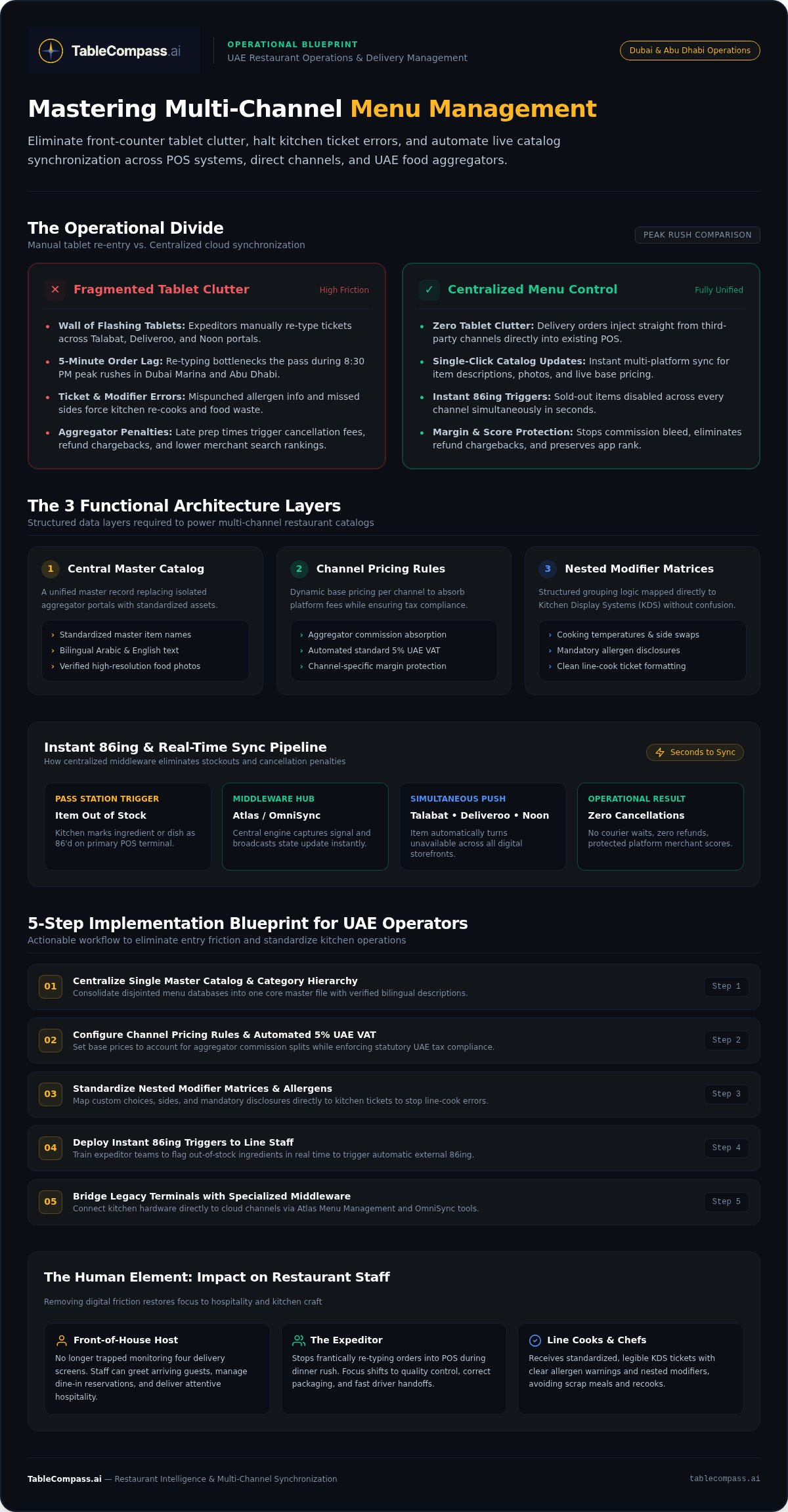
A unified digital catalog requires structured data architecture rather than simple text fields. Successful multi channel menu management relies on three functional layers:
- Centralized Catalogs and Categories: A single master record housing standardized item names, localized Arabic and English descriptions, and verified high-resolution food photography.
- Channel-Specific Pricing Rules: The flexibility to adjust base prices per channel to absorb platform commissions, while automatically accounting for the standard 5% UAE VAT across all listings.
- Nested Modifier Matrices: Structured groupings for sides, cooking temperatures, and mandatory allergen disclosures that map directly to kitchen display systems without confusing your line cooks.
Why Traditional Manual Menu Updates Are Costing Your Brand
Updating aggregator dashboards by hand isn't just tedious; it introduces severe operational lag. Logging into four separate portals to tweak prices or adjust descriptions burns hours of manager time each week. During a busy weekend rush in Downtown Dubai, that administrative delay causes immediate friction.
When dine-in prices and third-party app rates fall out of sync unintentionally, customer trust drops. Worse, mismatched modifier options cause ticket errors on the pass, resulting in incorrect dispatches, bad online reviews, and aggregator cancellation penalties that directly eat your bottom line.
The Hidden Operational Costs of Tablet Clutter and Manual Menu Entry
Walk into any bustling kitchen in Dubai Marina or Abu Dhabi's Al Maryah Island during peak hours. You'll likely see a dedicated staff member trapped behind a wall of blinking tablets, frantically re-punching orders into an internal system. This setup creates serious friction. Staff spend dozens of hours every month simply copying data from one touch screen to another. Typing errors inevitably slip through, creating a direct pipeline to customer refunds, wasted food, and kitchen delays.
Centralized control solves this bottleneck by establishing seamless restaurant POS synchronization across all channels. When your digital storefronts feed straight into your main system, manual re-entry vanishes. Integrating this backend flow with proper multi channel menu management ensures that when an ingredient runs out on the line, it gets switched off across every external portal simultaneously.
The True Financial Drain of Kitchen Bottlenecks and Mispicks
Manual order input introduces lag right when kitchens need speed the most. A five-minute delay re-typing a large delivery order backs up the pass, leading to crowded pickup counters packed with waiting couriers. In fast-paced dining hubs, these delays trigger steep operational costs:
- Aggregator Penalties: Late prep times and cancelled tickets incur financial penalties from delivery platforms alongside full chargebacks.
- Wasted Prep and Re-cooks: Mispunching a "no dairy" modifier forces the line to scrap meals and cook them again from scratch.
- Algorithmic Demotion: Consistent delays and cancellations hurt your merchant score, dropping your brand lower in app search rankings.
Human Stress in High-Volume Delivery Kitchens
Countertop tablet chaos takes a heavy toll on front-of-house teams. Asking a host to greet arriving dine-in guests, handle reservations, answer the phone, and monitor four separate delivery screens breeds exhaustion and turnover. When workers juggle disjointed devices, attention splits, and overall service quality drops.
Practical steps make an immediate difference. Consolidating incoming orders into a unified stream removes manual data entry, letting your hosts focus entirely on guest hospitality. If you want to eliminate hardware sprawl and streamline front-of-house workflows, exploring an integrated solution via TableCompass.ai can help restore order to your line while protecting your margins.
Core Features to Prioritize in Menu Management Middleware
Point-to-point connections cannot keep up with high-volume hospitality. Traditional integrations rely on static pipelines that push basic data in one direction, creating operational blind spots whenever an item sells out. Modern multi channel menu management requires dynamic middleware acting as a bidirectional bridge. It doesn't just broadcast catalog updates; it constantly ingests live kitchen sales data to keep stock counts perfectly balanced across your entire network.
Selecting the right middleware framework forms the foundation of any resilient restaurant aggregator integration solution. When evaluating software options for your UAE branches, ensure the system includes role-based permission tiers and clear audit tracking. Kitchen supervisors need access to toggle ingredient availability instantly, while overall pricing modifications and menu layout revisions remain locked down to head-office operations teams.
Centralized Catalog Publishing and Instant 86ing
Out-of-stock items require immediate, global intervention. When your line runs out of wagyu beef on a Friday evening, your kitchen manager shouldn't have to navigate three third-party apps to disable the dish. Centralized platforms give you a single-click master switch that 86es items across every connected sales channel within seconds.
Beyond emergency toggles, robust middleware automates daily operational shifts. You can establish automated scheduling rules to swap seamlessly between breakfast, lunch, and late-night menus across online channels without requiring manual staff input at the counter.
Dynamic Channel Pricing and Modifier Customization
Managing margins across delivery platforms requires flexible pricing control. High-performance multi channel menu management software lets you apply differential markups across aggregator channels to offset steep platform commission fees, all while maintaining lower price points for direct dine-in or branded app ordering.
Your middleware must also handle deep modifier nesting without dropping critical order parameters. Whether mapping cooking temperatures for steaks, custom drink combos, or complex side swaps, nested logic guarantees the kitchen ticket matches the customer's exact configuration. It also enforces regulatory compliance automatically, ensuring the UAE's mandatory 5% VAT displays clearly and accurately across all digital receipts.
How to Implement Multi Channel Menu Management: A 5-Step Blueprint
Transitioning from a chaotic line of delivery tablets to a unified digital ecosystem requires methodical execution. You cannot simply flip a switch during a dinner rush. Rolling out effective multi channel menu management demands a structured, step-by-step framework to ensure zero downtime and prevent lost revenue across your regional branches.
- Audit Existing Menu Databases: Export your live menus from every delivery app and point of sale. Strip out duplicate dish entries, retired seasonal items, and contradictory pricing models.
- Establish a Master Catalog Hierarchy: Group items into clean parent categories with unified pricing, standardized descriptions, and uniform photo assets.
- Integrate Your Tech Infrastructure: Connect your master layout using robust POS middleware for UAE hospitality to establish uninterrupted data pipelines between local terminals and remote app marketplaces.
- Conduct Sandbox Channel Validation: Place controlled test orders across individual aggregator platforms during off-peak hours to confirm prices, modifiers, and prep notes sync without data corruption.
- Execute Go-Live and Monitor Pass Throughput: Decommission redundant hardware, activate automated order flows, and track real-time kitchen completion rates.
Standardizing Names, Modifiers, and Master SKUs
Inconsistent naming between what a guest sees and what prints on the kitchen ticket ruins throughput. If an online guest selects "Truffle Burger" on Deliveroo, the pass expeditor cannot receive a ticket labeled simply "Burger Spec." Align internal product codes with clear customer labels, ensure dietary flags remain consistent across platforms, and verify every modifier group maps to a defined kitchen routing station.
Staff Training and Operational Go-Live Best Practices
Even the cleanest digital architecture fails if your front-of-house team doesn't understand the new workflow. Train floor supervisors and expeditors on single-dashboard 86ing before launch so they know exactly how to pull an item from service instantly without touching multiple screens.
Review comprehensive order discrepancy logs 48 hours after deployment to spot any edge-case routing glitches. Once steady-state operations are established, enforce weekly catalog audits to maintain database integrity across all outlets. Ready to eliminate manual order management? Book a platform walkthrough with TableCompass.ai to transform your kitchen operations today.
Unifying Digital Hospitality: The Power of Atlas and OmniSync
Modern multi channel menu management requires an operational engine that bridges legacy hospitality setups with cutting-edge cloud networks. Atlas Menu Management serves as this central command center. Instead of manually pushing changes to disparate portals, Atlas gives operators a unified dashboard to adjust product listings, modify dish pairings, and deploy live catalog updates everywhere simultaneously.
Working hand in hand with Atlas, the OmniSync middleware suite handles the heavy technical lifting behind the pass. OmniSync forms a reliable communication highway between your physical POS hardware and external aggregators. By automating ticket routing and inventory reconciliation, it removes human error entirely. The system also connects smoothly with tools like GuestConnect AI, turning live ordering patterns into automated, personalized guest communication workflows.
Real-Time Control Across the Entire UAE Delivery Ecosystem
Operating a hospitality group across Dubai, Abu Dhabi, and Sharjah means navigating a fast, high-density delivery market. Atlas and OmniSync provide native compatibility with dominant regional platforms like Talabat, Deliveroo, and Noon. Powered by Universal Bridge middleware, the platform eliminates structural friction between incompatible software setups, allowing multi-unit brands to enforce unified pricing, clean descriptions, and brand standards across every branch without operational lag.
Scaling Direct Channels Alongside Marketplace Aggregators
Aggregators bring volume, but owned channels build long-term enterprise value. Centralizing your master menu allows you to expand high-margin direct dining channels without adding administrative burdens to your front-of-house staff:
- QR Table Ordering & Pay: Deliver dynamic, contactless dining experiences inside your dining rooms with instant catalog updates that match kitchen inventory in real time.
- White-Label Mobile Apps: Deploy fully branded iOS and Android ordering channels, capturing repeat customers and driving loyalty without paying marketplace commissions.
- Satellite AI Integration: Leverage intelligent automation modules to optimize order distribution, forecast prep volumes, and maintain high throughput during sudden rushes.
Mastering multi channel menu management isn't just about cutting tablet clutter; it's about building a scalable foundation. By uniting physical dining rooms, mobile ordering apps, and delivery marketplaces under one umbrella, operators protect their kitchen sanity and preserve their operating margins.
Take Full Control of Your Kitchen's Digital Footprint
Operating a high-volume concept in the Emirates doesn't have to mean enduring front-counter tablet chaos, manual entry mistakes, and margin bleed. Centralizing your operations with modern multi channel menu management transforms fragmented delivery workflows into a disciplined, high-throughput kitchen engine. When you establish Atlas Menu Management as your operational nerve center and deploy OmniSync to connect your physical POS directly to aggregators, instant catalog updates and real-time 86ing become effortless.
Eliminating kitchen bottlenecks protects your profitability while giving your hospitality team the operational stability needed to deliver exceptional dining experiences. Purpose-built for the fast-evolving UAE restaurant ecosystem, this architecture ensures your brand scales seamlessly across every aggregator marketplace and direct ordering touchpoint. Streamline your menus with TableCompass.ai and build a unified, future-ready operation today.
Frequently Asked Questions
What is multi channel menu management and how does it work for restaurants?
Multi channel menu management connects your kitchen POS directly to external ordering channels through a centralized software dashboard. Instead of logging into separate aggregator portals, operators modify one master record. The system automatically pushes dish names, descriptions, and category adjustments to delivery apps, direct mobile applications, and QR table ordering setups instantly, ensuring consistent customer experiences and eliminating manual data maintenance across your business.
Can centralized menu software update Talabat, Deliveroo, and Noon simultaneously?
Yes, centralized platforms update Talabat, Deliveroo, and Noon at the same time using direct API middleware. When you publish a menu update through Atlas Menu Management, the changes broadcast to each connected aggregator within seconds. This eliminates the need for managers to manually log into individual delivery portals, preventing pricing discrepancies and maintaining brand alignment across UAE delivery apps.
How quickly does an 86ed item reflect across online delivery aggregators?
Out-of-stock items update across delivery aggregators almost instantaneously, typically within a few seconds of triggering the change. When floor staff toggle an item as unavailable in your POS or central dashboard, OmniSync middleware immediately pushes the status change to Talabat, Deliveroo, and Noon. This real-time response prevents customers from ordering sold-out dishes, avoiding kitchen delays and costly order cancellation penalties.
Will implementing menu middleware require replacing our existing POS hardware?
No, deploying menu management middleware doesn't require buying new POS hardware. Solutions like Universal Bridge integrate directly with your existing legacy POS terminals and cloud setups. The software acts as an intelligent communication layer between your current terminals and external delivery networks. You keep your current hardware intact while gaining automated order synchronization and centralized catalog control without capital-heavy equipment upgrades.
How does dynamic menu pricing work across different third-party delivery channels?
Dynamic pricing lets you set distinct price tiers for each ordering channel from a single master menu catalog. Operators can maintain baseline rates for in-house dining and direct ordering while applying calculated percentage markups on third-party aggregators to absorb platform commission fees. The software manages these variations automatically, ensuring compliant 5% UAE VAT calculations across all published customer receipts.
Can multi channel menu systems manage different menus for multiple restaurant branches?
Yes, multi channel menu management platforms support multi-location brands with localized catalog configurations. You can establish a global master menu while tailoring specific items, modifier groups, and price points for individual branches in Dubai, Abu Dhabi, or Sharjah. Outlet managers can adjust local stock availability without altering corporate brand settings, keeping group-wide menus organized while maintaining operational flexibility per location.
What happens to incoming online orders if our restaurant internet connection drops?
When local internet connectivity drops, cloud-based middleware queues incoming delivery orders on secure remote servers instead of losing them. Once the connection re-establishes, the system immediately routes the queued tickets to your kitchen display or printers. Some setups can also notify managers via cellular backup alerts or temporarily pause delivery storefronts to stop unfulfilled tickets from accumulating during prolonged network outages.