How UAE Restaurants Can Reduce Food Delivery Commissions Without Abandoning Aggregators
Abandoning delivery aggregators isn’t the only way to reduce food delivery commissions. For UAE restaurants, a practical approach is to keep the discovery and reach aggregators provide while directing suitable repeat orders through restaurant-owned channels. To decide which orders to shift, compare what each channel contributes after commissions, promotions, refunds, fulfilment costs, and the work involved in processing orders.
If delivery sales look strong but margins feel tight, review the costs behind the gross total. This guide explains how to compare channel contributions, introduce direct ordering in manageable steps, and reduce the manual work of coordinating menus and orders. It also covers how POS and aggregator integration through OmniSync can connect order processing and inventory management in your restaurant’s workflow.
Key Takeaways
- Compare each delivery channel by its actual contribution, not just its sales total.
- Use platform fees, refunds, restaurant-funded promotions, and fulfilment costs to build a consistent comparison.
- Choose an aggregator, direct, or hybrid approach based on customer discovery, channel control, and workflow needs.
- Test direct ordering with a manageable customer group before making wider changes to reduce food delivery commissions.
- Connect ordering workflows with tools such as OmniSync to reduce manual order processing and inventory work.
Why UAE Restaurants Need a Better Strategy to Reduce Food Delivery Commissions
A delivery order can increase revenue without adding the same amount to a restaurant’s margin. Commission is one deduction, but the order may also involve other platform charges, restaurant-funded discounts, refunds, packaging, and staff time for preparation and handoff. The details depend on each platform agreement and the restaurant’s own costs.
A busy aggregator dashboard alone won’t show whether a channel is performing well. Assess what remains after order-related costs, and consider the channel’s role in bringing in customers. Gross order value is recorded before deductions; restaurant contribution is what remains after the costs of receiving, preparing, and fulfilling an order are accounted for.
What does a delivery commission mean for a restaurant order?
A delivery commission is a platform fee applied to orders under the restaurant’s agreement. It reduces the amount retained from an order, but it may not represent the channel’s total cost. Other charges can appear separately, and the effect of a promotion depends on who funds it and how the agreement treats it.
For an accurate assessment in the UAE, use your own platform agreements and statements rather than fee ranges from another market. Record each charge by type and compare the statement with the agreement. This makes it easier to compare platforms consistently and identify deductions that need explaining.
Why commission reduction is a channel decision, not a switch
Aggregators can help diners discover a restaurant and provide an established ordering channel. Direct ordering through a restaurant’s own online channel can support a more direct customer relationship. The approaches serve different purposes, as this online food ordering industry overview also illustrates.
Direct ordering doesn’t automatically mean the restaurant handles delivery. It changes where the customer places the order, while fulfilment remains a separate decision. Before moving orders, decide how customers will find the direct channel, how orders will reach the kitchen, and how they will be fulfilled.
For UAE operators, the goal is to balance reach, control, and contribution, rather than assume one channel suits every diner or occasion. Keep channels that bring useful discovery, and identify repeat customers or order types that may fit direct ordering. Compare the results using the same cost definitions and reporting period.
- Record platform commission separately from other agreement charges.
- Include order-related costs, not just platform deductions, when calculating contribution.
- Compare aggregator and direct channels by their purpose as well as their costs.
This channel-level view gives restaurant teams a practical starting point to reduce food delivery commissions without giving up useful discovery or creating extra workflow pressure through an abrupt change.
Calculate What Each UAE Delivery Channel Actually Contributes
A channel comparison is useful only when every order is measured on the same basis. Build a worksheet from your order records, platform statements, and restaurant cost data. Use the same reporting period for each channel, such as a calendar month, and apply one definition of net sales throughout. This shows whether sales volume is translating into contribution without relying on generic fee assumptions or UAE-wide benchmarks.
Which figures should operators compare?
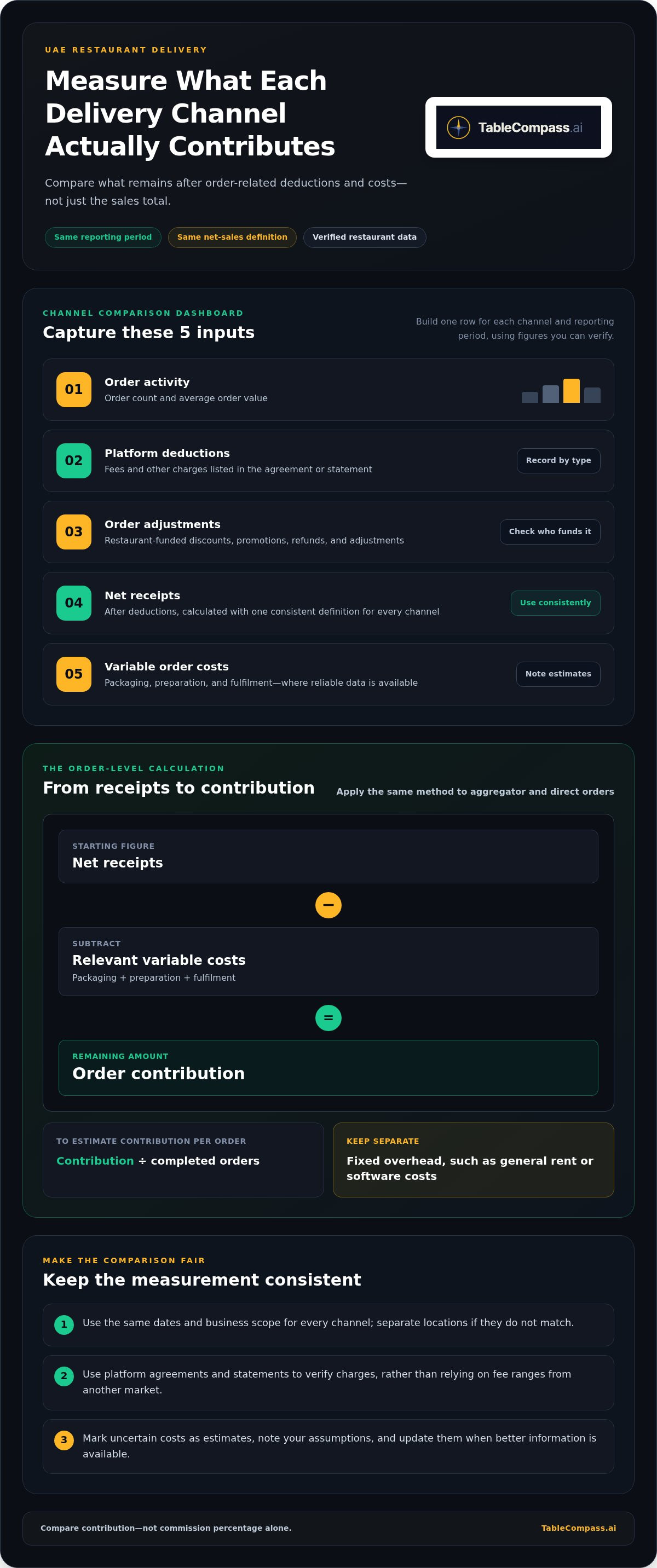
Create one row for each channel and reporting period. Record activity and deductions using figures you can verify. If a cost is uncertain, mark it as an estimate rather than treating it as exact.
- Order count and average order value.
- Platform fees and other deductions shown in the agreement or statement.
- Restaurant-funded discounts, promotions, refunds, and adjustments.
- Net receipts after deductions, calculated with the same definition for every channel.
- Packaging, preparation, and fulfilment costs where reliable data is available.
Check that each channel covers the same dates and business scope. If one channel includes a branch that another does not, separate the locations before comparing. Add a notes column for assumptions, such as estimated packaging costs, and update the estimates when better information is available.
How can a restaurant estimate order contribution?
Start with the money received for orders after platform deductions and restaurant-funded promotions. Subtract the variable costs of preparing and fulfilling those orders. Use the same calculation for aggregator and direct orders so that differences reflect channel performance, not inconsistent bookkeeping.
Commission percentage alone doesn’t measure channel profitability. Contribution depends on what the restaurant retains after order-related deductions and costs.
- Set the starting figure: Record net receipts for the channel and period you’re assessing.
- Subtract relevant variable costs: Include restaurant-borne packaging, preparation, and fulfilment costs when reliable data is available.
- Calculate the comparison: Divide the remaining contribution by completed orders to estimate contribution per order.
Keep fixed overhead, such as general rent or software costs, separate from this order-level calculation. These expenses matter to the restaurant’s overall finances, but inconsistent allocations can hide differences between channels. If you allocate overhead for a broader analysis, document the method and apply it consistently.
Review the worksheet regularly and investigate changes instead of reacting to one unusually strong or weak period. A channel with higher sales may also have more refunds or restaurant-funded offers. A lower-volume channel may require different preparation or customer support. Use the comparison to decide what role each channel should play, rather than forcing every channel into the same role.
Once the figures are clear, choose where to focus your next test to reduce food delivery commissions. Connected restaurant ordering workflows can help reduce manual handling across channels and make order records easier to manage.
Aggregator, Direct, or Hybrid: Compare the Routes to Lower Commissions
Choosing a delivery model isn’t simply a choice between platform fees and commission-free orders. Each route serves a different purpose: aggregators can help diners discover a restaurant, while direct channels give the restaurant more ownership of the ordering experience. For UAE operators, the right mix can vary by brand, location, menu, and customer habits. Compare the operational trade-offs before changing where orders come from.
| Channel | Customer discovery | Channel control | Workflow needs | Fee exposure |
|---|---|---|---|---|
| Aggregator | Can introduce the restaurant to platform users who may not know it. | Ordering takes place within the platform’s environment and agreement. | Orders, menus, and availability need to be managed alongside other channels. | Platform charges and other agreement-based deductions affect receipts. |
| Direct | Usually relies on customers knowing how to find the restaurant’s ordering option. | The restaurant leads the ordering experience and customer engagement. | Requires a process to receive, confirm, and manage direct orders. | Platform commission may not apply, but other channel and fulfilment costs still matter. |
| Hybrid | Combines aggregator discovery with restaurant-led routes for direct demand. | Control is split across channels, with the restaurant managing its own direct option. | Teams need joined-up processes for orders, menus, and availability. | Costs depend on the order mix and the terms and expenses of each route. |
When do aggregator orders still make strategic sense?
Aggregator orders may be valuable when they reach customers who haven’t discovered the restaurant through its own channels. Assess each platform using your order and contribution data, not its headline commission alone. Leaving a platform abruptly can remove a discovery route before direct demand is ready to replace it. Base the decision on channel performance and customer behaviour.
What can direct and hybrid ordering change?
Direct ordering gives repeat customers another way to order and supports restaurant-led engagement. A white-label mobile app or QR Table Ordering & Pay can provide direct-order routes, but the restaurant still needs clear processes to receive and fulfil those orders. Direct ordering changes where an order is placed; it doesn’t automatically change how delivery is arranged.
A hybrid model can retain selected aggregator activity while building direct demand over time. For example, a restaurant might keep an aggregator that attracts new diners while making its own ordering channel easy for returning guests to use. A multi-location brand can test different mixes by location when customer patterns and operations differ. Track the results before expanding the approach.
To reduce food delivery commissions without losing useful reach, decide which channel should serve which customer need. Make the direct option easy to find through restaurant-owned communications and guest touchpoints, while keeping aggregator operations manageable. The aim is a balanced channel system, not a blanket shift that adds friction for staff or diners.
A Practical UAE Restaurant Plan to Reduce Food Delivery Commissions
Changing the channel mix is an operational project as well as a marketing decision. A gradual rollout helps UAE restaurant teams maintain service standards while learning which customers will use direct ordering and what the process requires. Base the plan on your channel records, staff capacity, and customer journey.
- Set a baseline. Record orders, receipts, costs, refunds, and promotions by channel for a consistent period. Note staff effort and recurring order-handling issues.
- Prioritize an opportunity. Choose a customer group or order type that may suit direct ordering, such as returning guests who already know the restaurant. Keep aggregator activity that supports discovery during the test.
- Prepare the workflow. Align menus and item availability, assign responsibility for receiving and handling orders, and decide how staff will resolve missing or incorrect items.
- Run a focused pilot. Promote the direct option through one relevant customer touchpoint instead of changing every channel at once. Make sure the team can process an order from receipt through handoff.
- Review and refine. Compare results with the baseline. Keep, adjust, or expand the test based on customer response, contribution, and operational effort.
Prepare the restaurant before promoting direct orders
Check that item names, prices, availability, and ordering instructions match wherever customers can place an order. Assign clear responsibility for receiving, preparing, and resolving direct orders, especially during busy service periods. Then choose a touchpoint that fits the existing guest journey, such as a restaurant-owned digital channel used by returning customers. A clear process helps ensure that an additional ordering route doesn’t become another source of confusion.
Run a measured pilot and refine the channel mix
Before launch, record the baseline and decide what you’ll review. Track direct-order uptake, staff effort, order accuracy, and contribution using data the restaurant can collect consistently. Record customer feedback and workflow problems as well. If staff spend more time correcting orders or guests struggle to find the direct option, improve the process before widening the test. An early change in sales alone doesn’t prove that the restaurant is saving money.
Connected workflows can make a mixed-channel operation easier to coordinate. A POS synchronization guide can help teams map how orders move between a POS and ordering channels, keeping the rollout focused on processes rather than assumptions. For an overview of connected ordering workflows, review TableCompass.ai solutions.
Connect Ordering Channels with TableCompass to Make the Strategy Operational
A hybrid ordering strategy works best when orders flow cleanly into restaurant operations. If staff have to re-enter details from different channels, the process adds work and creates opportunities for mistakes. Connected systems can support the operational backbone: aggregator orders flow into the POS, while direct-ordering options serve customers through restaurant-led channels. Each tool has a distinct role.
Use OmniSync to connect aggregator orders with restaurant operations
OmniSync synchronizes a restaurant’s POS system with third-party food delivery aggregators. It automates order processing and inventory management to reduce manual entry and related errors. This helps connect aggregator activity with the systems staff use to manage orders and stock.
Before introducing a connection, map how orders are handled today. Identify where staff re-enter order details, update availability, or reconcile information across systems. Then define the workflow you want: aggregator orders should be captured accurately, reach the restaurant’s POS, and be reflected in inventory processes. Automation supports that flow, while staff continue to review operations and records as part of normal service.
This connection is useful when a restaurant retains aggregator channels as part of a hybrid approach. Rather than treating each platform as a separate island, operators can connect aggregator ordering with core restaurant operations. A UAE restaurant aggregator integration guide can help teams consider how channel connections fit into an existing setup.
Build direct ordering alongside the connected workflow
Direct-ordering tools complement the aggregator connection; they are separate from OmniSync’s POS-to-aggregator role. TableCompass.ai offers white-label mobile apps for restaurant-branded ordering, as well as QR Table Ordering & Pay. These options give customers direct routes to order while selected aggregators continue to support discovery and reach.
Plan how direct orders will fit into day-to-day operations. Align item availability and ordering instructions, assign responsibility for monitoring incoming orders, and make sure staff know how to handle changes or customer questions. The workflow will depend on the restaurant’s chosen ordering channels and service model. Keep the handoff straightforward for guests and staff.
A practical setup connects channel strategy to the work behind it: retain aggregators where they serve a purpose, use direct options for restaurant-led ordering, and give staff clear processes for each. Review order records and inventory handling after changes so the operating model stays manageable as the channel mix develops.
For UAE restaurants looking to reduce food delivery commissions while keeping ordering operations connected, explore TableCompass.ai solutions for aggregator integration and direct-ordering options.
Make Your Next Channel Decision With Confidence
Turn your findings into one manageable operational decision. Choose a channel adjustment your team can observe, set a review point, and agree in advance what would count as a useful result. This helps you reduce food delivery commissions deliberately instead of making a broad change based on assumptions or pressure to move every customer at once.
Use the results to shape the next test. If the process is clear and customers respond, build on it. If staff workload or the customer experience needs attention, refine the workflow before expanding. Each measured step gives your restaurant a stronger basis for decisions that suit its customers, staff, and UAE operations.
Explore TableCompass.ai solutions for connected restaurant ordering and take the next step toward a more coordinated channel strategy. Your team can make progress without giving up reach that still matters.
Frequently Asked Questions
Can a restaurant reduce food delivery commissions without leaving aggregators?
Yes. A UAE restaurant can keep selected aggregator channels while developing direct orders from returning customers. Decide which channels support discovery and which are suitable for repeat ordering, then monitor each separately. For example, keep an aggregator active while making the restaurant’s own ordering option easy for dine-in guests to find for their next order. Expand the approach when the team can manage the extra channel smoothly.
How do I calculate the commission I pay on delivery orders?
Use the platform statement and your current agreement. Identify the orders included, the basis for calculating commission, and the amount deducted for the same reporting period. Divide the commission total by the relevant order value to calculate the effective commission percentage for that period. Treat adjustments, refunds, and discounts consistently, and record any deduction that doesn’t match the agreement for follow-up.
Can I negotiate a lower commission with a food delivery platform?
Any change to commission depends on the platform agreement and the restaurant’s commercial terms. Before making a channel decision, review your order history, locations, menu range, and records of deductions or promotions. Compare the documented terms with actual order contribution, and include any proposed change in the calculation only once it is reflected in the agreement. Don’t base a decision on an assumed saving.
Does direct ordering mean my restaurant needs its own delivery drivers?
No. Direct ordering describes where a customer places an order, not who delivers it. A restaurant might use an existing delivery setup, offer collection where practical, or choose another arrangement that fits its operations. Before promoting direct orders, decide how customers will receive them and make that option clear during ordering. Don’t imply that an order includes delivery unless the restaurant’s process provides it.
How can a restaurant promote direct ordering to repeat customers?
Make the option visible at a natural point in the guest relationship. A restaurant could include ordering details on a receipt, share them through its own customer communications, or display a QR code in the venue. Keep the message brief and explain how to find the menu and place an order. Start with one touchpoint, then review whether customers use it and whether staff can support the process consistently.
Can POS integration help reduce manual work on aggregator orders?
Yes. A connection between the POS and aggregator channels can send order information into restaurant operations without staff re-entering each order. This can reduce repetitive work and the risk of transcription mistakes, though teams still need to manage exceptions such as unavailable items or order changes. Check that staff can see and process incoming orders clearly, then review recurring errors to improve the workflow.
Should a UAE restaurant stop using every delivery aggregator?
Not automatically. Removing every aggregator may also remove a route through which new diners discover the restaurant. Review each platform’s order activity, agreement terms, customer reach, and contribution before deciding whether to retain or pause it. Different locations or customer groups may call for different choices. Make changes in stages so you can observe the effects on demand and daily operations before committing to a wider exit.