How to Use Personalized Marketing for Restaurant Loyalty
Personalized marketing for restaurant customers works best when a restaurant uses what it learns about guests to improve how it serves them. Use visit and order patterns to shape relevant messages and offers, then carry those preferences into the dining experience. The aim is not to send more campaigns, but to make each interaction feel consistent and useful.
For restaurants in the UAE, personalization can turn customer data into practical decisions, from whom to reach to which offer may be relevant. But marketing alone has limits: a message feels personal only when the service and experience behind it follow through.
This guide explains how to build customer segments, personalize communications and service, measure campaign performance, and shape offers around guest needs and revenue goals. It also covers how connected restaurant systems can help teams move from scattered customer information to a more coordinated approach to loyalty.
Key Takeaways
- Build customer segments from visit patterns, order preferences, and feedback so each message has a clear reason to reach its audience.
- Localize promotions to the tastes and dining habits of the communities each UAE restaurant serves.
- Track campaign results against a clear goal, such as repeat visits, offer redemption, or orders for a featured item.
- Shape offers around guest behavior and business priorities rather than sending the same discount to everyone.
- Connect marketing with the service experience so guest preferences can inform both communications and restaurant operations.
How does personalization affect customer loyalty in restaurants?
Personalization can strengthen loyalty when restaurants use guest preferences to improve real interactions. Personalized marketing for restaurant customers works best when relevant messages connect with service guests recognize.
-
Collect and Enrich Customer Data
Gather details guests choose to share through bookings, orders, loyalty sign-ups, and feedback. After a visit, ask a focused question about whether a dish, service detail, or occasion shaped their experience. Record only information that helps the team respond usefully. For example, a guest’s preference for vegetarian dishes can guide future recommendations, while unrelated personal details add little value.
-
Unify Guest Profiles and Restaurant Data
Bring reservation notes, order patterns, feedback, and campaign responses into a consistent guest profile. Bloom Intelligence’s 2026 research identifies synchronization across POS, WiFi, reservations, reviews, and online ordering as the minimum requirement for effective personalization. Match records carefully so one diner’s preferences aren’t assigned to someone else. Review duplicates and outdated details before using a profile to shape a message or service decision.
-
Segment Audiences for Personalization
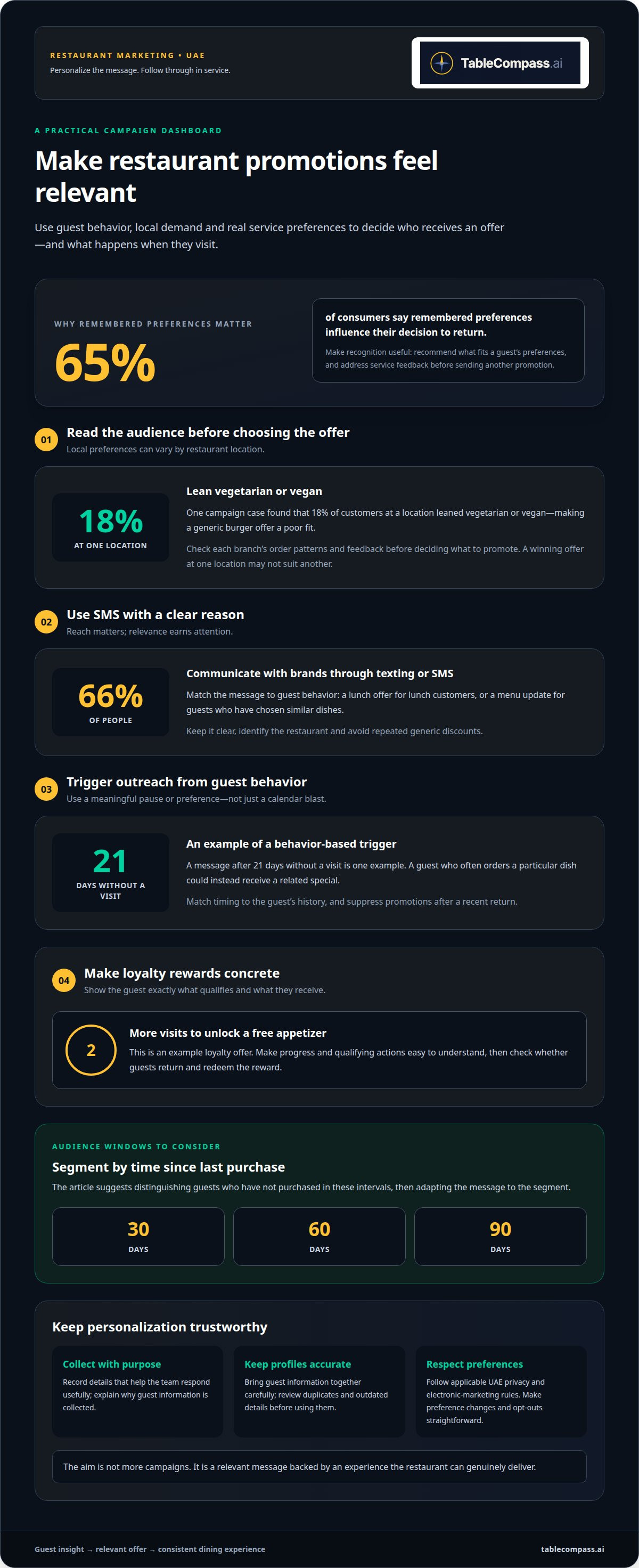
Group guests by behavior that suggests a practical next step, such as order preference, visit frequency, or time since their last purchase. You can distinguish weekly customers from guests who haven’t purchased in 30, 60, or 90 days. Then adapt the message to the segment. A returning guest may appreciate a relevant menu update, while a frequent diner may respond better to recognition of an established preference.
For UAE restaurants, handle guest information and marketing permissions in line with applicable privacy and electronic-marketing rules. Explain why you collect details, use them for a clear purpose, and make it straightforward for guests to change their communication preferences or opt out.
Privacy missteps and excessive messages can weaken trust. A diner who repeatedly receives promotions for dishes they never order may ignore future messages or unsubscribe. Set a sensible contact rhythm, monitor opt-outs, and remove messages that no longer fit a guest’s behaviour. Treat corrections and complaints as useful feedback for improving the experience.
Use data to make the next visit feel considered, not monitored. If a guest often chooses vegetarian dishes, a relevant new menu recommendation is more useful than a generic promotion. If feedback points to a service issue, address that first. Personalized marketing for restaurant customers should reflect what the restaurant can genuinely deliver. The 65% of consumers who say remembered preferences influence their return decision highlight why consistent recognition matters.
Why does marketing-only personalization underperform?
A tailored message can still disappoint if the offer ignores local demand or the visit experience. In UAE restaurants, connect each promotion to a guest’s behaviour, location, and ability to redeem it.
- Localize promotions to real demand. Compare order patterns and customer feedback by location before choosing a promotion. A campaign case found that 18% of one location’s customers leaned vegetarian or vegan, making a generic burger offer a poor fit. In another location-based case, audience segmentation helped cut 70% of the targeted area. Use those lessons carefully: check which menu items sell locally, then tailor the offer to that audience. A promotion that suits one branch may not suit another.
- Make SMS messages relevant and restrained. 66% of people communicate with brands through texting or SMS, so the channel can put an offer directly in front of a guest. But a message earns attention only when its timing and content fit. Send a lunch offer to guests who order lunch, or share a menu update with customers who previously chose similar dishes. Keep the message clear, identify the restaurant, and make the next action easy to understand. Avoid sending repeated generic discounts that train customers to wait for a lower price.
- Connect loyalty offers to repeat visits. Give guests a specific reason to return, rather than a broad promise of future rewards. For example, tell a loyalty member they can unlock a free appetizer after two more visits. Make the progress and qualifying action easy to understand at checkout or in the follow-up message. Then check whether guests return and redeem the reward. If the offer creates visits but little interest in the rest of the menu, adjust the reward or pair it with a relevant dish.
- Trigger promotions from behavior. Use a meaningful action or pause as the trigger, not a fixed calendar blast. A message after 21 days without a visit is one example; a guest who often orders a particular dish could receive a related special instead. Match the timing and offer to the guest’s history, and suppress promotions after a recent return. This keeps outreach connected to the dining relationship. Restaurant marketing software can help coordinate audience rules and campaign delivery as those programs grow.
Before launching, map each promotion to a specific audience, branch, and guest action. Connected restaurant marketing software can support that workflow when separate campaigns become difficult to coordinate.
Make the reward concrete: guests should be able to see the qualifying action and payoff, such as a free appetiser after two more visits.
Campaign analytics and performance metrics
Measure each campaign against a defined restaurant outcome, not message volume alone. These steps connect guest responses with business performance.
- Set one primary objective. Decide whether a UAE restaurant campaign should increase visits, encourage trial of a new dish, or raise orders for a featured drink. Choose one primary outcome before writing the message. Then select supporting measures, such as offer redemptions or repeat visits. A campaign introducing a new menu item needs a different success measure from one intended to bring back inactive guests.
- Record a baseline before launch. Note how the promoted item or audience performed before the campaign. For example, record existing orders for a new dish at the branch where you plan to promote it. Keep the dates, locations, audience rules, offer, and channel together in one campaign record. This gives your team a clear comparison point and helps distinguish campaign response from ordinary changes in restaurant demand.
- Track the full response path. Follow each step from message delivery to a restaurant action. Record delivered messages, clicks or offer views, redemptions, and resulting orders where those measures are available. Calculate the redemption rate by dividing redeemed offers by delivered offers, then compare results across branches or audience segments. A high click rate with few redemptions may indicate that the offer, timing, or redemption process needs adjusting.
- Compare like with like. Assess a promoted location against its own baseline or a comparable branch without the same campaign. Keep the offer, audience, and measurement period visible in your notes. A restaurant campaign case achieved a 3x increase in trial for new menu items in previously underperforming markets. A localized campaign case produced a 2x lift in featured drink orders in targeted locations. Treat these as examples, not forecasts for every UAE outlet.
- Use results to make the next decision. If redemptions rise but visits do not, review whether guests used the offer during an existing visit rather than returning because of it. If a featured item sells better in selected locations, consider whether local demand supports extending the promotion. Share findings with marketing and restaurant teams, then document the change for the next campaign. This connects customer response with menu decisions and future investment.
Personalized offers and revenue
Use offers to influence a measurable restaurant outcome, not simply to distribute discounts. In the UAE, connect each promotion to guest preferences, menu economics, and the order you want to encourage.
- Set the commercial goal first. Choose whether the offer should prompt a return visit, introduce a dish, or increase add-ons. Then select a measure that matches that goal, such as repeat orders or average order value. 80% of consumers are likelier to buy when brands offer personalized experiences. Treat that finding as a reason to test relevant offers, not a forecast of your restaurant’s results.
- Match the offer to the guest’s behaviour. Recommend a complementary drink to a guest who often orders a particular main course, or feature a suitable new dish based on previous choices. More than half of customers say personalization makes them more likely to spend more at a restaurant. Keep the suggestion useful, and give guests a clear way to redeem it while ordering or dining.
- Protect margin while adding value. Avoid making a discount the default. Test a relevant add-on, a menu pairing, or a reward tied to an additional purchase. Behavior-based in-store upsell offers can lift restaurant average order value by 10-30%. Review item cost and redemption behavior alongside sales, so an increase in order value doesn’t conceal an unprofitable offer.
- Use messages to prompt action. A personalized text can highlight an offer aligned with a guest’s history, while a mobile campaign can make redemption straightforward. 72% of people made a purchase after receiving a text from a brand. Use that result as context, then track your own campaign’s orders and redemptions. McKinsey reports that companies leveraging customer behavior data outperform peers by 85% in sales growth and 25% in gross margin.
- Test and refine each offer. Compare a targeted promotion with a suitable alternative, keeping the audience and measurement consistent. For example, exclude vegetarian and vegan customers from a generic burger promotion, then assess response among the remaining audience. One restaurant campaign case improved click-through rate by 42% after that exclusion. Apply the learning to your menu and local audience, then stop or revise offers that produce clicks without profitable orders.
Marketing versus operational personalization
Marketing personalization shapes what guests hear; operational personalization shapes what they experience after responding. UAE restaurants build loyalty when the message and the meal align.
- Separate the message from the experience. Marketing decides which guest receives a campaign, through which channel, and with what offer. Operations determine whether the restaurant can deliver on that promise. For example, an offer featuring a popular dish should reflect current menu availability at the branch receiving the guest. Treat these as connected responsibilities, not separate projects. A relevant message loses credibility if the restaurant cannot fulfil its promise.
- Carry useful preferences into service. Let marketing insights inform practical service decisions, such as a guest’s preferred ordering channel or a dish they often choose. Give staff concise, relevant context rather than a long customer history. For example, a returning guest who orders a particular meal could receive a suitable recommendation, provided it is available and fits the current menu. Keep recognition helpful, not intrusive.
- Give teams a shared view of the guest journey. Coordinate campaign information with reservations, ordering, and service workflows. A guest who responds to a promotion should find the same offer details at the restaurant, without having to explain them again. Assign clear ownership: marketing maintains campaign terms, while restaurant teams communicate availability and redemption steps. This handoff turns a digital response into a smoother visit.
- Connect channels with service delivery. A guest may discover a promotion by email, review it in a mobile app, then order in person. Companies adopting omnichannel marketing see 250% higher engagement than companies using single-channel approaches. For a UAE restaurant, the practical lesson is to keep offer details consistent across channels and staff touchpoints. Check the menu, ordering flow, and team guidance before a campaign goes live.
- Diagnose where the experience breaks. Compare campaign responses with what happens during fulfilment. If guests engage but staff report confusion, clarify the offer instructions. If an item is unavailable at a branch, adjust the promotion or its audience before sending more messages. Gather feedback from guests and frontline teams after launch. This reveals whether the issue lies in the message, the operating process, or the handoff between them.
Build a more connected approach by aligning restaurant marketing and operations around the guest experience.
TableCompass.ai: OmniSync
TableCompass.ai offers OmniSync, which connects restaurant POS systems with food aggregators to support a more coordinated operational foundation for personalized service. It can help when managing information and workflows across systems becomes difficult.
For related needs, Atlas Menu Management centralizes menu control, while GuestConnect AI supports customer engagement through intelligent automation. A White-Label Mobile App gives restaurants another direct channel for guest interactions. Choose the components that fit the challenge, whether it is coordinating systems, managing menus, or engaging guests.
Personalization works best when the customer-facing message aligns with what the restaurant can deliver. Explore how OmniSync can fit your restaurant’s operations, or visit tablecompass.ai to learn more.
Build Your Next Loyalty Touchpoint
Choose one guest interaction to improve first, such as recognizing a repeat order or making a promotion easier to redeem. Assign a clear owner for the change and make it part of the service routine. A small, well-integrated improvement can give your restaurant a practical starting point for personalized marketing for restaurant customers.
Then identify the operational support that fits the challenge. TableCompass.ai offers OmniSync, Atlas Menu Management, and GuestConnect AI. These tools address different parts of restaurant operations and customer engagement, so your next step can focus on the problem your team needs to solve.
When you’re ready to discuss how a more connected approach could fit your restaurant, contact TableCompass.ai to discuss personalization. Take the next step with a clear priority, a focused team, and a guest experience worth returning for.
Frequently Asked Questions
How do restaurants operationalize personalization effectively?
Make personalization part of a repeatable service workflow, with clear responsibilities for each team. For example, a host can note a guest’s seating preference for a later visit. Decide where the preference belongs, who updates it, and when it should be reviewed. Keep the process simple enough for busy shifts, and remove details that no longer help staff serve the guest.
How should restaurants measure personalization success?
Measure whether a personalized interaction changed customer behaviour, then compare it with a suitable baseline or control group. For example, track repeat bookings among guests who receive a tailored follow-up against similar guests who do not. Also watch for negative signals, including unsubscribes, complaints, and unused offers. Review results by campaign and branch, then decide whether to continue, refine, or stop the activity.
What are the best examples of personalization in dining?
Useful examples include adapting recommendations to a guest’s occasion, remembering a preferred seating area, or acknowledging a returning guest’s usual order. A restaurant might suggest a quieter table for a business meeting or a family-friendly menu choice when a guest books with children. Keep recognition natural and relevant. Staff should never make a guest feel watched or reveal personal details in front of others.
What is targeted online marketing for restaurants?
Targeted online marketing shows digital messages to selected audiences based on relevant signals, rather than sending one campaign to everyone. A UAE restaurant could promote a weekday lunch menu to nearby customers who have shown interest in lunch options. Choose the audience, message, and intended action before publishing. Then assess whether the campaign brought useful visits or orders, not merely views.
What customer data can restaurants collect and use for personalization?
Restaurants can use information customers provide, such as contact preferences, booking details, order history, and feedback. Operational records can also show which menu categories guests choose or whether they dine in or order takeaway. Collect only details with a clear service or marketing purpose. Explain how information will be used, protect access, and provide a straightforward way to change communication preferences.
How can restaurants personalize offers using purchase history and dining preferences?
Look for a pattern in previous orders, then make a relevant suggestion that suits the guest’s current context. A takeaway regular might receive a reminder about a new collection option, while a diner who often shares dishes could see a suitable group-menu feature. Keep the offer easy to understand and redeem. Review whether customers act on it and whether the resulting order supports the restaurant’s commercial goal.
What are effective personalized marketing channels for restaurants, such as email, SMS, and apps?
Choose a channel based on the message and the guest’s stated communication preference. Email suits detailed updates, SMS works for concise, timely information, and an app can support ongoing brand interactions. Avoid duplicating the same promotion across every channel. For example, send a menu announcement by email and reserve a brief reminder for guests who chose mobile messages.
How can restaurants segment customers for targeted campaigns?
Build segments around a clear decision the restaurant can act on. Useful groups might include dine-in guests, takeaway customers, people who book for groups, or customers interested in a particular cuisine category. Keep each group focused enough to support a distinct message. Review membership as behaviour changes, and avoid categories that do not lead to a more relevant experience or useful campaign.