Hidden Costs of Third-Party Delivery: How Fees Work
Restaurant delivery apps commonly charge restaurants a commission of 15-30% per order, while promotions, processing charges and other deductions can reduce the payout further. These hidden costs of third-party delivery services mean the amount left after each order may be very different from the customer’s bill.
Delivery can look busy while margins remain under pressure. Leaving marketplaces is not always the answer: they can help restaurants reach customers, but relying on them for every order can make costs and customer relationships harder to manage.
This guide explains how commissions and other deductions work, why delivery models affect total costs, and how direct ordering compares. You’ll learn what to include when assessing an order’s contribution, how promotions and operational complexity affect the result, and how connected systems can give UAE restaurants a clearer view of performance.
Key Takeaways
- Compare each delivery channel by the net amount retained per order, not just the headline commission.
- Track refunds, order adjustments, packaging, and promotion spending to see where the payout is being reduced.
- Use marketplaces to reach new diners, then make direct ordering easy for returning customers.
- Review menu prices and availability across channels together to reduce outdated listings and staff corrections.
- Choose a delivery setup that connects orders and reporting when managing separate platforms creates kitchen confusion or fragmented data.
Benefits of direct ordering and custom delivery apps
Direct online ordering gives a UAE restaurant more control over order flow, customer relationships, and repeat sales. The useful comparison is each order’s net contribution, not simply the number of orders received.
Customer Data and Repeat Orders
When a restaurant owns its direct-order data, it can use order history to understand and communicate with diners. Delivery apps may retain customer data, limiting access to order history and opportunities to encourage repeat orders.
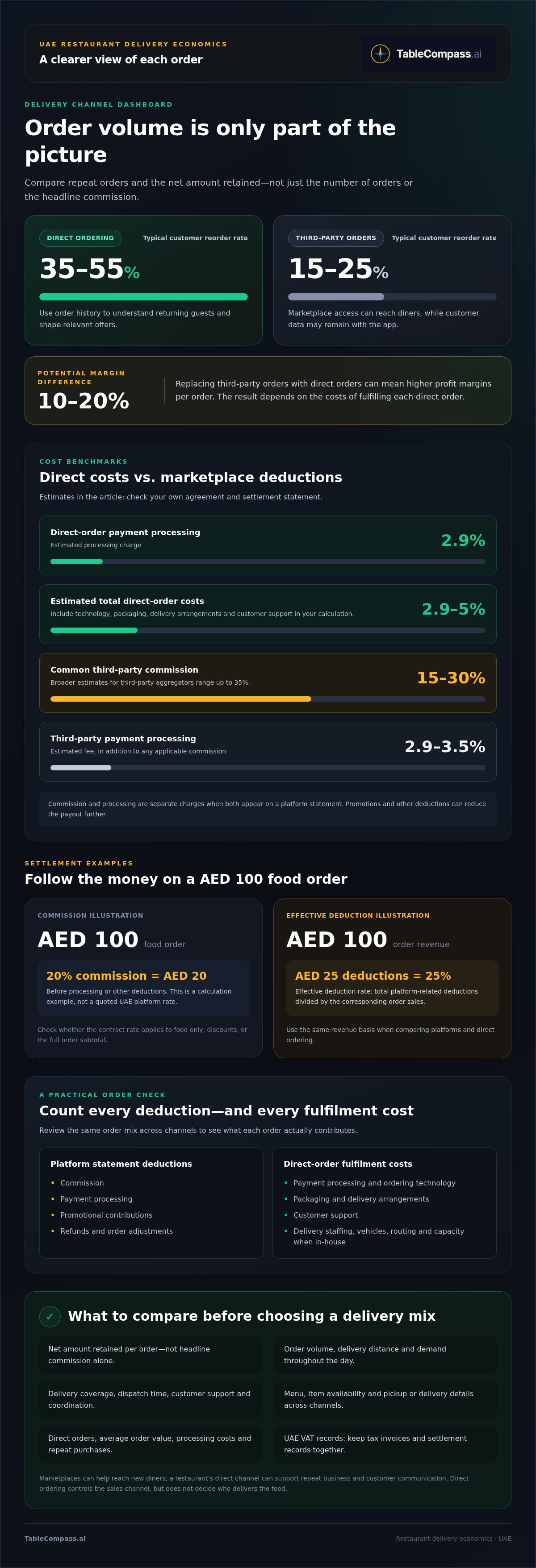
That difference matters for repeat business: typical direct customer reorder rates are 35-55%, compared with 15-25% for third-party orders. A restaurant can use its own ordering channel to recognize returning guests, review popular dishes, and shape relevant offers. For example, compare returning-customer orders across channels before deciding where to focus loyalty messages.
Reducing Delivery Costs Through Direct Orders
Direct ordering reduces delivery-related deductions by moving the transaction away from marketplace commission structures. Direct-order payment processing is estimated at 2.9%, with total direct-order costs estimated at 2.9-5%.
That doesn’t make every direct order free to fulfil. Include payment processing, ordering technology, packaging, delivery arrangements, and customer support in the calculation. Then compare that total with the deductions and promotional spending attached to marketplace orders. The potential difference is material: replacing third-party orders with direct orders can mean 10-20% higher profit margins per order.
To assess a technology investment, track direct orders, average order value, processing costs, and repeat purchases together. A custom app or online ordering system makes sense when the additional contribution from direct orders covers its operating costs.
Moving Customers to Direct Ordering
To encourage marketplace customers to order directly next time, give them a clear reason to return to the restaurant’s own channel. Marketplaces can introduce new diners, while direct channels can support repeat business and customer communication.
Start with a consistent experience across channels. Keep menus, item availability, and pickup or delivery details accurate, then make the direct-order option easy to find on receipts, packaging, and the restaurant’s own digital channels. Use customer feedback and order patterns to make offers relevant, rather than discounting every order. Track direct-channel repeat orders against the 35-55% typical reorder rate to evaluate progress.
Direct Delivery Versus In-House Service
In the UAE, third-party delivery involves a per-order platform cost in exchange for access to an external delivery network. In-house delivery shifts costs toward staffing, vehicles, routing, and delivery capacity. The better fit depends on order volume, delivery distance, and demand throughout the day.
For a Dubai restaurant, an in-house rider may suit steady local demand, while a third-party fleet can absorb unpredictable peaks without requiring the restaurant to maintain the same capacity during quieter periods. Compare both models using the same order mix, and include dispatch time, delivery coverage, customer support, and coordination. Direct ordering controls the sales channel, but does not determine who delivers the food.
Delivery-app commission fees and layered deductions
A headline commission is only one line on a restaurant’s delivery-platform statement. To understand the actual cost, compare every deduction with the order revenue it applies to.
Advertised Commission Rates
Advertised commission rates are the percentage platforms deduct from qualifying orders, but the applicable rate depends on the agreement and delivery arrangement. Food delivery platforms commonly charge restaurants 15-30% commission per order; broader estimates for third-party aggregators range from 15 to 35%.
For a UAE restaurant, treat quoted rates as a starting point, not a guaranteed offer. Compare the contract’s rate with the settlement statement, and note whether the percentage applies to food only, discounts, or the full order subtotal. That definition changes the deduction.
Commissions and Processing Fees
Commission and payment processing are separate charges when both appear on a platform statement. Estimates place third-party delivery payment processing fees at 2.9-3.5%, in addition to any applicable commission.
For example, on a د.إ100 food order, a 20% commission would equal د.إ20 before processing or other deductions. The example illustrates the calculation only; it isn’t a quoted UAE platform rate. Check the settlement for processing, refunds, driver adjustments, and promotional contributions, then match each line to its contract term.
UAE restaurants should also review how platform service charges and restaurant sales are documented for VAT accounting. Keep tax invoices and settlement records together, and distinguish charges billed to customers from fees billed to the restaurant, as their accounting treatment may differ.
Calculating the True Commission Rate
Calculate the effective commission rate by dividing total platform-related deductions by the order revenue used for comparison. This matters because a stated percentage may understate the share lost after other charges.
For each settlement period, add commission, processing, promotional contributions, refunds, and adjustments. Divide that total by the corresponding order sales, then compare the result across platforms and direct ordering. Keep the same revenue basis each time. If a د.إ100 order produces د.إ25 in combined deductions, the effective deduction rate is 25%.
Before signing or renewing, review the contract’s commission basis, exclusivity, term, cancellation fees, notice period, payout timing, and dispute process. These clauses determine how long the terms apply and how disputed deductions are handled.
Regulations and VAT on Platform Fees
For UAE VAT records, separate platform charges from restaurant sales and retain the related invoices and settlement statements. Identify who billed each charge, which service it covers, and how the document records tax, then reconcile those entries with the restaurant’s records.
Don’t assume every deduction has the same VAT treatment: a platform fee, customer charge, refund, and restaurant sale are different transaction lines. A monthly reconciliation by order and fee type gives the restaurant a clear record for its accounting review.
How Do Food Delivery Apps Charge Restaurants?
Beyond commission, delivery platforms may add promotion, processing, and service charges. Promotional fees are estimated at 1-5%, while delivery fees passed to restaurants are estimated at 5-15%.
Platform Fees Beyond Commission
Additional platform fees cover services or exposure beyond the basic commission. Each charge reduces the amount available for food, labour, packaging, and other restaurant costs.
A platform may charge for promotional participation, payment processing, or delivery-related services. Visibility campaigns can put an offer in front of more app users, but measure the restaurant’s contribution against the orders generated. Separate restaurant-funded discounts from platform charges: both affect the final return, but in different ways.
For each campaign, record its dates, eligible menu items, and resulting order volume. This lets the operator compare promotion spending with sales instead of treating every charge as part of one commission.
Total Delivery Costs
Total delivery costs include platform deductions and the restaurant’s own costs of fulfilling an order. This broader view matters because the commission line on a statement does not show the full delivery cost.
Estimates place third-party delivery costs at 35-48% of restaurant revenue. Treat this as a broad estimate, not a fixed UAE platform tariff: actual deductions depend on the agreement, selected promotions, order mix, and delivery arrangement.
Build a channel-level calculation that groups commission, promotional contributions, processing and service charges, refunds, and delivery-related deductions. Then add restaurant costs such as packaging and food, while keeping discounts on a separate line. This breakdown shows whether an offer brought additional demand or shifted existing orders into a more expensive channel.
Review the same categories across each platform’s settlement statements. Using consistent categories makes monthly comparisons useful, even when platforms label similar charges differently.
Effects on Restaurant Profit Margins
Delivery fees reduce profit margins by taking a share of revenue before the restaurant pays its other operating costs. This matters especially when food and fulfilment already account for much of an order’s selling price.
For example, if a restaurant’s delivery-related deductions total 35% of channel revenue, that share is unavailable for ingredients, wages, rent, and profit. The 35-48% delivery-cost estimate illustrates why an order count alone cannot measure profitability.
Promotional spending can also reduce the margin without changing the menu price. Compare promoted orders with similar non-promoted orders, including discounts and platform charges, to see whether the added visibility led to enough additional sales.
A restaurant management system can help organize channel performance alongside operating data, giving owners a clearer basis for reviewing delivery profitability.
Additional marketing and promotional charges
Promotions, express delivery, refunds, and order adjustments can change a delivery order’s final value. For UAE restaurants, reviewing these charges by channel helps separate customer convenience from deductions that reduce revenue.
Promotions and Visibility
A promotion is a funded offer or paid placement intended to influence demand within a delivery app. It can increase visibility, but the restaurant needs to know who funds each discount and how the platform records it.
Before joining a campaign, record the offer, eligible dishes, dates, and restaurant contribution. Then compare promoted orders with similar orders outside the campaign. A higher order count alone does not prove profitability if discounts go to customers who would have ordered anyway.
Check settlement statements for separate entries covering discounts, promotional participation, and visibility. A 15% delivery charge appears in a restaurant-delivery example, but it shouldn’t be treated as a standard UAE rate. The practical step is to compare each charge with the signed platform terms and campaign records.
Express-Delivery Charges
Express delivery is a faster service option that can add charges because it requires rapid fulfilment and delivery capacity. In Dubai, urgent or express delivery may carry extra charges, and peak demand can push delivery-platform surge prices to double or triple the original fee.
That difference can affect customer convenience and order conversion. Check whether express delivery changes the restaurant’s payout, the customer’s delivery charge, or both. Compare standard and urgent orders separately, including timing, fulfilment requirements, and any resulting customer complaints.
During a busy Dubai evening, for example, distinguish platform surge pricing from the restaurant’s menu prices. This prevents a delivery charge from being mistaken for restaurant revenue.
Refunds and Order Adjustments
A refund returns some or all of an order’s value to the customer and may be deducted directly from the restaurant’s platform payout. Driver adjustments or issue reports can also reduce earnings, so match each deduction to a reason and order reference.
Third-party delivery orders are reported to go wrong 8-12% of the time, while customer service costs are estimated at 0.5-2%. These figures make order-level tracking useful: record missing items, late arrivals, packaging problems, and refund outcomes, then compare patterns across channels.
If a statement lists a chargeback or disputed transaction, match it to the order record and platform decision. Keep the receipt, preparation details, and customer communication together. A clear evidence trail helps staff spot recurring operational issues rather than treating every refund as an isolated hidden cost.
Aggregator versus all-in-one delivery systems
An aggregator connects diners and restaurants through a marketplace; an all-in-one system coordinates ordering channels and operational workflows. For UAE restaurant owners, compare how each model affects kitchen flow, channel control, and operating expenses.
How an Aggregator Model Works
With an aggregator, each marketplace may bring its own interface, terms, promotions, and reporting. That reach can help a restaurant attract new customers, but staff may have to manage multiple partner devices during a busy service.
For example, if three delivery platforms send orders to separate screens, kitchen staff must monitor each one and enter details into other systems. Managing multiple devices can slow responses, increase errors, and create confusion during peak periods. Owners may also have to combine reports manually to compare sales and deductions.
What an All-in-One System Coordinates
An all-in-one delivery system coordinates ordering channels and operational data through a shared workflow. It can connect marketplace orders with the restaurant’s existing systems, reducing the need for staff to move information between disconnected screens.
That coordination is different from delivery logistics: software can organize order information, but does not provide riders or guarantee delivery. For a UAE operator, the practical benefit is a more consistent view of incoming orders, menu updates, and channel performance. A manager can review a consolidated report rather than assemble figures from separate platform dashboards.
Compare the Operating Model
Compare the models over a full shift, not just during quiet periods. A Friday evening in Dubai, for example, may reveal different pressure points than a weekday lunch. Map the workflow from order receipt through kitchen preparation, dispatch, customer issue handling, and payout reconciliation.
- Count the screens staff must monitor during peak service.
- Record order corrections and missed tickets by channel.
- Compare platform reports with restaurant sales records.
- Separate software coordination from delivery fleet expenses.
These checks reveal whether marketplace reach creates extra operational work and where connected systems could simplify the process.
Keep Flexibility in the Delivery Mix
Restaurants don’t have to choose between marketplace reach and direct control for every order. Use aggregators to attract customers, then make the restaurant’s own ordering channel easy for repeat diners to find. An internal delivery fleet can handle predictable demand, while third-party delivery capacity can help manage unexpected surges.
That approach keeps the operating model flexible: the kitchen receives organized orders, owners compare channel performance, and delivery capacity can adapt to demand. To review how connected delivery-channel workflows could fit your restaurant, explore the available approach.
TableCompass.ai: OmniSync
TableCompass.ai’s OmniSync connects restaurant POS systems with food aggregators, helping UAE teams coordinate orders across delivery channels. It suits restaurants whose staff are juggling separate platform workflows and whose owners need a more unified operational view.
For restaurants managing menus across channels, Atlas provides centralized menu control. GuestConnect AI supports customer engagement, while the White-Label App enables direct ordering as part of a broader digital setup. These tools connect operations with guest touchpoints; they do not provide delivery riders or replace the delivery platform itself.
Consider OmniSync when fragmented order handling makes service harder to manage. To explore how it could fit your restaurant’s workflow, visit TableCompass.ai.
Build a Delivery Model You Can Measure
Make reviewing the hidden costs of third-party delivery services a regular operating habit. Choose a recent settlement period, then trace sample orders from customer payment through kitchen preparation, handoff, deductions, and final payout. This reveals where information gets lost and which costs need attention.
Next, choose one improvement to test, such as standardizing order handling across channels or reviewing how promotions are recorded. Assign an owner, document the current workflow, and compare the same measures after the change. A focused test gives your team a practical basis for deciding what to adjust without disrupting every delivery channel at once.
For UAE restaurant operators, a connected workflow can make it easier to manage orders and assess channel performance. Explore how TableCompass.ai may fit your operation, then decide which workflow to streamline first. Contact TableCompass.ai to explore delivery options and take the next step with a clearer operating plan.
Frequently Asked Questions
What commission fees do third-party delivery apps charge restaurants in the UAE?
A commonly reported commission range is 15-30% per order, but each UAE restaurant’s rate depends on its platform agreement and delivery arrangement. The commission is only one part of the hidden costs of third-party delivery services. Check the contract’s order-value basis, including how discounts affect the calculation. Record each platform’s rate and basis so you can compare settlement periods consistently.
How do delivery app fees affect restaurant profit margins and menu prices?
Fees reduce the revenue left to cover ingredients, labour, packaging, and other operating expenses, so restaurants may adjust app menu prices. Restaurant app prices are commonly reported as 10-20% higher to help offset platform fees. Compare the same dish’s direct and app prices, then calculate its contribution after discounts and deductions. A higher app price may offset costs, but it can also affect customer demand.
What are the costs of promotions, discounts, and sponsored listings on delivery apps?
Promotional costs depend on campaign terms, including who funds the discount and whether the restaurant pays for added visibility. A restaurant might fund a dish discount and also join a paid placement campaign, creating separate deductions. Before participating, record the offer, eligible items, dates, and restaurant contribution. Afterwards, compare campaign orders with sales outside the promotion to assess whether the extra exposure brought useful demand.
Who pays for refunds, missing orders, and customer complaints on delivery platforms?
The platform’s order review and restaurant agreement determine how a refund or missing-item claim affects the restaurant’s payout. Customer refunds may be deducted from the settlement, while driver adjustments or issue reports can create other deductions. Match each case to the order record, receipt, preparation details, and platform decision. This helps distinguish a kitchen packing error from a delivery issue when reviewing complaints.
How do payment processing and payout fees vary across delivery services in the UAE?
Processing and payout charges depend on the service agreement and settlement structure. A statement may show processing as a separate deduction, while payout timing or bundled deposits affect when revenue reaches the restaurant. Compare platform statements by matching order totals, fee labels, deductions, and deposit amounts for the same period. This reveals whether a charge relates to a transaction or to how funds are settled.
How can restaurants calculate the true cost per delivery order on an app?
Add each order’s commission, processing charge, promotion contribution, refunds, and adjustments, then include food and packaging costs. Divide the total by completed orders to calculate the cost per order. This makes the hidden costs of third-party delivery services visible across menu items and platforms. Keep cancelled orders separate and use consistent cost categories to see whether a popular dish remains worthwhile after deductions.