Future-proofing a restaurant business through smarter operations
A restaurant that can adapt is better prepared than one built around a single way of working. Future-proofing a restaurant business means creating flexible operations that can respond to changing customer preferences, staffing pressures, and shifts in how people order and dine. It is not about predicting every disruption. It is about making practical decisions that leave room to adjust.
In the UAE, restaurants serve guests with varied tastes and expectations across dine-in, takeaway, and digital channels. Technology matters, but lasting resilience also depends on how well your people, processes, and customer experience work together.
This guide explains how to build flexibility through AI-assisted planning, staff training, clear customer communication, digital ordering, and diverse revenue streams. You will find practical ways to review operations, choose improvements that address real bottlenecks, and phase changes around your restaurant’s priorities. The goal is a connected operation that can adapt without losing sight of the food and hospitality at its heart.
Key Takeaways
- Use sales patterns, menu performance, and service bottlenecks to guide AI-assisted decisions instead of relying on guesswork.
- Train staff to explain ingredients and allergens clearly, and make ordering and payment steps straightforward for guests.
- Keep delivery, pickup, and reservations easy to manage by connecting digital channels to the restaurant’s day-to-day workflow.
- Reduce dependence on a single source of income by exploring suitable options such as private events and takeaway.
- Build adaptability through small, purposeful operational improvements that support your restaurant’s customers, team, and long-term priorities.
1. AI-assisted menu planning and labor management
For a UAE restaurant, AI-assisted planning can help turn changing sales patterns into practical menu and staffing decisions. Review item sales, customer interactions, and front- and back-of-house workflows together. For example, a dish popular during busy evening service may need a different prep plan from one ordered mostly at lunch.
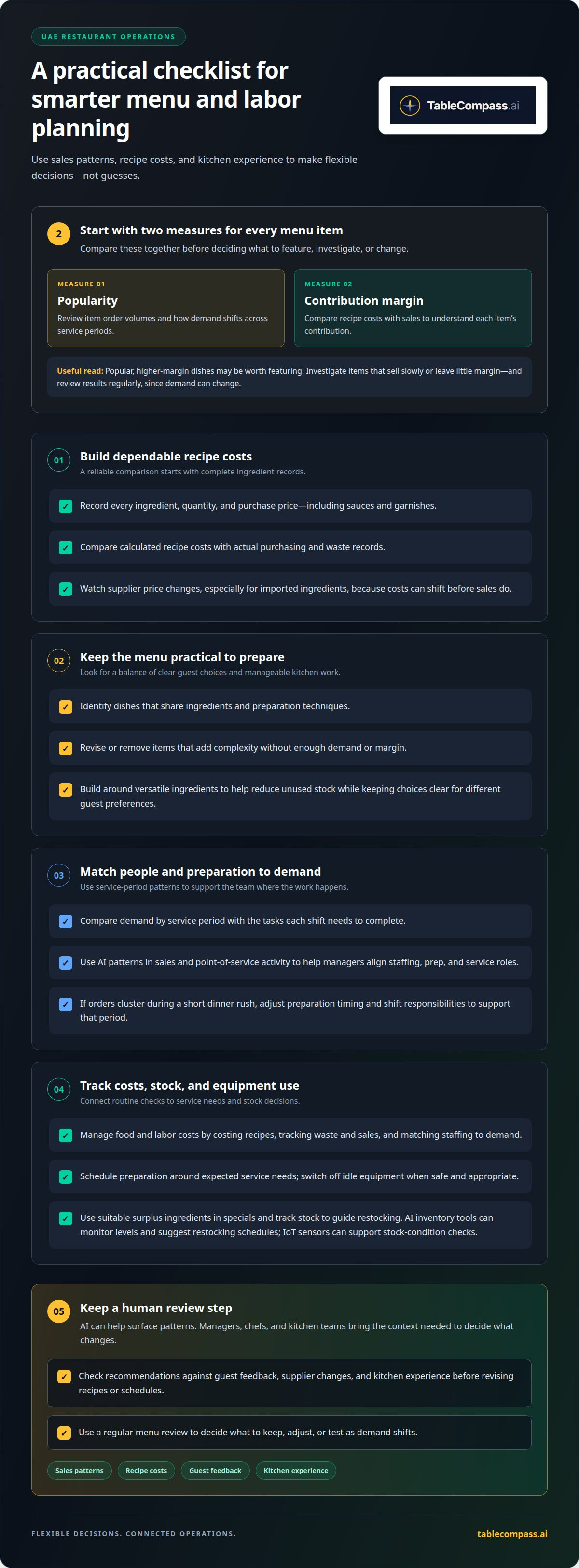
Start by comparing two measures for each menu item: popularity and contribution margin. Compare order volumes with recipe costs to identify popular, higher-margin dishes worth featuring, then investigate items that sell slowly or leave little margin. Demand can shift, so review the results regularly instead of treating one strong week as a lasting pattern.
Recipe costing gives these comparisons a reliable foundation. Record every ingredient, quantity, and purchase price, including sauces and garnishes. Then compare calculated costs with actual purchasing and waste records. If a dish uses imported ingredients, for example, a supplier price change may affect its margin before sales change.
Simplifying the menu can make preparation and stock control easier. Look for dishes that share ingredients and techniques, then revise or remove items that add complexity without enough demand or margin. A focused menu built around versatile ingredients can reduce unused stock while still offering clear choices for different guest preferences.
For labor planning, compare demand by service period with the tasks each shift must complete. AI can help identify patterns in sales and point-of-service activity; managers can use those findings to align staffing, prep, and service roles. If orders cluster during a short dinner rush, adjust preparation timing and shift responsibilities to support that period.
Manage food, labor, and energy costs by costing recipes, tracking waste and sales, matching staffing to demand, and reviewing equipment use. Schedule prep around expected service needs, and switch off idle equipment when it is safe and appropriate.
Sustainability practices can help reduce costs and environmental impact. Use suitable surplus ingredients in menu specials and track stock to guide restocking. AI-powered inventory tools can help monitor stock levels and suggest restocking schedules, while IoT sensors can support stock-condition checks.
Keep a human review step. Check AI recommendations against guest feedback, supplier changes, and kitchen experience before revising recipes or schedules. A regular menu review, for example, can reveal shifting demand and give chefs and managers a consistent opportunity to decide what to keep, adjust, or test.
2. Staff training and customer transparency
In a UAE restaurant, clear service depends on staff knowing what each dish contains and how orders move from table to kitchen. Train servers to answer ingredient and allergen questions accurately, and show them where to find current recipe information. Before a new menu item launches, brief the team and give them a consistent way to explain its ingredients.
Transparency should also extend to the ordering experience. QR menus can make table ordering and payment easier, while menu links can share ingredient traceability details. Keep digital information aligned with the kitchen’s current recipes. If a supplier change affects a dish, update the menu details and brief staff before guests ask.
Use guest feedback to understand changing expectations instead of relying on assumptions. Review comments, common questions, order patterns, and service complaints together. Repeated questions about spice levels, for example, may signal a need for clearer menu descriptions. Complaints about long waits after ordering could point to a handoff problem between the floor and kitchen.
Technology should remove friction, not add obstacles. Test the QR menu on a phone before launch, make sure dish details are easy to scan, and ensure staff can help guests who prefer ordering face to face. A failed payment flow or outdated menu can disrupt service, so assign someone to check digital menus whenever recipes or prices change.
For UAE restaurants, compliance planning should cover food safety, employment, licensing, and data privacy. Build these areas into staff onboarding and operating procedures, and keep training materials and customer-facing information consistent with applicable requirements. Explain safe food handling, clarify job responsibilities, and limit access to customer information to relevant tasks.
Menu customization can help a restaurant test customer interest without rebuilding its entire offer. Start with clear choices, such as permitted ingredient adjustments or portion preferences, and teach staff how to record them accurately. For a more experimental option, 3D food printing can be tested through a high-margin novelty item. Use guest responses to decide whether it merits a place on the menu.
Keep operational changes manageable. After a service period, review guest comments with the team and choose one issue to address, such as unclear allergen information or confusing digital ordering. Assign an owner, update the relevant menu or training material, then check whether the same feedback continues.
For operators who want to connect feedback with day-to-day service workflows, restaurant operations tools can support a more coordinated guest experience.
3. Delivery, pickup, and reservation platforms
Hospitality now extends beyond the dining room: guests may discover your restaurant online, reserve a table, or order dinner for delivery. Restaurants adapted during the pandemic by offering delivery and curbside pickup. Keep suitable options ready to operate, even if dine-in remains your main service. An ordering webpage or app can give guests another direct way to place takeaway orders.
Map each order from the guest’s screen to its final handoff. For delivery, staff need to receive the order, prepare and package it, then mark it ready. For pickup, explain where guests should collect food and how to identify their order. A clear process helps prevent confusion between dine-in tickets, takeaway bags, and arriving couriers.
Keep digital menus aligned with what the kitchen can serve. If a dish does not travel well, consider whether it belongs on the delivery menu. Choose packaging that helps food arrive hot and appealing, then test how dishes hold up between the kitchen and collection point. Clear descriptions also help guests choose without needing staff to explain every item.
Review the operating model behind each delivery channel. Some delivery services charge little or no money to the restaurant, so compare the service terms and order workflow with your own capacity. Consider preparation effort, packaging needs, handoff space, and whether incoming orders interrupt table service. Keep the channel only when the team can fulfil orders consistently.
Reservations need the same operational discipline. Use an online booking platform to show available tables, record the guest details needed for a booking, and give staff a shared view of upcoming arrivals. Set a clear process for updating availability when a table’s status changes. For example, return a cancelled booking to the system promptly.
Digital platforms work best when staff know which screen or device is responsible for each task. Assign someone to monitor incoming digital orders during service, and train another team member to handle pickup handoffs when the pass gets busy. If a table or dish appears unavailable on one channel but bookable on another, pause and correct the information before more orders arrive.
Track channel performance through practical service observations: note which orders arrive late, which dishes travel well, and when pickup congestion occurs. Use those patterns to adjust preparation timing, menu availability, or collection instructions. Embracing delivery and reservation platforms does not mean adding every channel. Choose the combination your kitchen, dining room, and team can support reliably.
4. Diversifying clients and revenue streams
A restaurant reliant on one dominant sales channel or client can feel disruptions more sharply. In the UAE, assess which guests, occasions, and services generate sales, then identify where demand depends on one source. A venue serving mostly weekday office lunches, for example, could test private events or weekend family dining.
Different business models bring different operating demands. Dine-in relies on the restaurant space and table service; takeaway serves guests collecting orders; delivery-only focuses on orders prepared for dispatch; franchising expands through a repeatable brand and operating model. Compare each option with your kitchen capacity, customer demand, team skills, and ability to deliver consistent food and service.
Private events can add a distinct revenue stream alongside regular service. Create an event menu, booking page, and photographs that clearly show the space and dishes. A restaurant might start with a small event format that fits its existing kitchen, then assess enquiries, staffing needs, and guest feedback before expanding.
Takeaway can reach customers beyond the dining room. Choose dishes that travel well, set clear collection instructions, and keep the menu practical for the kitchen. A dish that loses texture during transport may work better as a dine-in special, while a sturdier option may suit collection orders.
Revenue diversity also means avoiding excessive reliance on one client or customer group. Review sales by client type and occasion, then note which segments rise or fall together. If corporate catering makes up a large share, explore private dining or direct guest orders as additional channels. The goal is a balanced mix, not simply more activity.
Prepare for economic downturns and supply disruptions by mapping essential ingredients, identifying alternative menu choices, and reviewing supplier dependencies. If a key ingredient becomes unavailable, a tested substitution or seasonal special can help the kitchen keep serving. Record supplier changes clearly, and update recipes, staff guidance, and customer-facing menu details together.
Changing regulations require an assigned review process, not last-minute guesswork. Give a manager responsibility for monitoring official notices relevant to the restaurant, recording updates, and briefing affected staff. When a change applies, update the relevant procedure and keep the current version accessible to the team.
Evaluate each new revenue stream before committing kitchen time or marketing effort. Compare customer demand, preparation requirements, service impact, and fit with the restaurant’s existing strengths. A measured trial, such as offering event bookings on selected dates, gives the team useful feedback before a larger operational change.
5. Meaning of future-proofing a business
Future-proofing a restaurant business means building operations that can absorb change without losing control of service, costs, or customer experience. It is not about predicting every disruption. It is about preparing for plausible changes, such as a supplier interruption, a shift in ordering habits, or a new service channel, and deciding how the team will respond.
A long-term continuity and growth plan starts with a clear review of financial performance, menu results, customer groups, staff and guest satisfaction, competitors, and market reach. Choose priorities, assign owners, and set review points. If weekday lunch demand weakens, for example, assess the customer mix and service costs before changing opening hours or adding another offer.
Separate essential operations from optional activity. List the tasks that keep service running, such as receiving orders, preparing dishes, updating menu availability, and communicating changes to staff. Identify who can take over each task when its usual owner is unavailable. A simple handover note can prevent a missed delivery order or outdated menu from disrupting service.
Build scenarios around realistic pressure points rather than abstract risks. If a key ingredient is unavailable, decide which dishes to pause and which substitutions preserve the menu’s intent. If dine-in traffic drops, clarify how existing kitchen capacity could support takeaway or private events. Each scenario needs a decision-maker, a first action, and a way to communicate the change to guests.
Growth planning should connect customer demand with operational capacity. Review guest feedback, sales patterns, staffing needs, and kitchen workload before expanding a service or changing the menu. A new ordering channel supports growth only if the team can process its tickets without slowing table service or compromising order accuracy.
Phase improvements to protect cash flow and staff focus. Address urgent workflow problems first, then schedule larger changes around quieter trading periods and business goals. For each proposed investment, record the problem it solves, the responsible team, and the evidence that will show whether it helped. This gives managers a practical basis for continuing, adjusting, or stopping the change.
Make the plan a working document, not a file that sits untouched. Review it when supplier arrangements, guest preferences, or operating conditions change, and brief staff on revised responsibilities. In the UAE, restaurants serving varied customer groups can use guest feedback to assess whether their menu, service format, and communication remain relevant.
For a more connected view of restaurant operations, explore tools for restaurant continuity planning as you map your next steps.
TableCompass.ai: OmniSync
TableCompass.ai’s OmniSync connects restaurant POS systems with food aggregators. For UAE restaurants managing orders across these channels, the middleware helps coordinate the connections within daily operations.
Choose tools that match the challenge. Atlas centralizes menu management, while GuestConnect AI supports customer engagement through intelligent automation. The White-Label App gives restaurants an app under their own brand. These offerings address different priorities, from menu coordination to guest engagement and branded digital ordering.
If disconnected systems are making restaurant operations harder to manage, visit tablecompass.ai to discuss how OmniSync can fit your setup.
Build your next move on a stronger operating foundation
Future-proofing a restaurant business is not a one-off technology project. It is an ongoing commitment to spot operational strain, choose a focused improvement, and learn from how guests and staff respond. For your next step, select one operational priority and define what a better working day would look like for your team.
TableCompass.ai offers OmniSync, Atlas Menu Management, and GuestConnect AI to support restaurants’ digital operations. Consider how these tools fit your priorities, whether you want to connect systems, coordinate menu management, or support guest engagement. Start with the challenge you want to address, rather than adopting technology for its own sake.
When you’re ready to discuss your restaurant’s needs, contact TableCompass.ai. A clear next step can turn operational pressure into a practical plan, giving your team more room to deliver the hospitality your guests come for.
Frequently Asked Questions
What Does Future-Proofing Your Business Really Mean?
A UAE café could test a new breakfast offer before making it permanent. The manager can note guest reactions, kitchen workload, and whether the offer suits the café’s service style, then decide whether to keep or adjust it. A small, reviewable trial grounds the decision in experience rather than assumptions. Apply the same approach to other changes that could affect daily service.
What will restaurants look like post Covid-19?
Restaurants need to serve guests in different ways, from dining in to collecting an order. The focus is not on one ideal layout, but on a setup and workflow suited to the venue’s customers. A café with limited collection space, for example, can define a pickup point that keeps arriving guests clear of the main service queue. Review the arrangement as guest habits and service needs change.
What are the biggest trends shaping the future of the restaurant industry?
Important shifts include more digital guest interactions, greater attention to ingredient information, and increased use of data to guide decisions. In the UAE, restaurants serve guests with varied dining preferences, so test ideas with your own audience. Trial a dish description that clarifies spice levels, for example, then review guest questions and feedback. Treat trends as signals to investigate, not automatic instructions to change your concept.
How can restaurants use AI, automation, and data analytics to improve operations?
Use tools to surface patterns and reduce repetitive coordination, while keeping managers responsible for decisions. Review order timestamps to find where ticket handoffs slow down, then adjust the workflow and compare later service notes. Automation can route routine information between systems, while analytics can help managers spot recurring exceptions. Keep records consistent and give staff a clear process for correcting inaccurate menu or order information.
How can a restaurant diversify revenue through delivery, catering, subscriptions, and retail products?
Choose an additional revenue stream that fits your kitchen, brand, and customer base. A restaurant might test office catering with a small set of dishes, offer recurring meal packages, or sell a house-made sauce alongside dine-in service. Before expanding, define preparation, storage, packaging, and order-handling steps. Track customer response and workload together so added sales do not create service bottlenecks or distract the team from core dining.
How can restaurants build customer loyalty and adapt to changing dining preferences?
Build loyalty by delivering consistent visits and responding visibly to guest feedback. Ask staff to record recurring requests, such as smaller portions or clearer descriptions, then review those notes alongside customer comments. Make a focused adjustment and tell guests what changed. In the UAE, listening across dine-in and digital interactions can help restaurants respond to varied preferences without losing their identity.