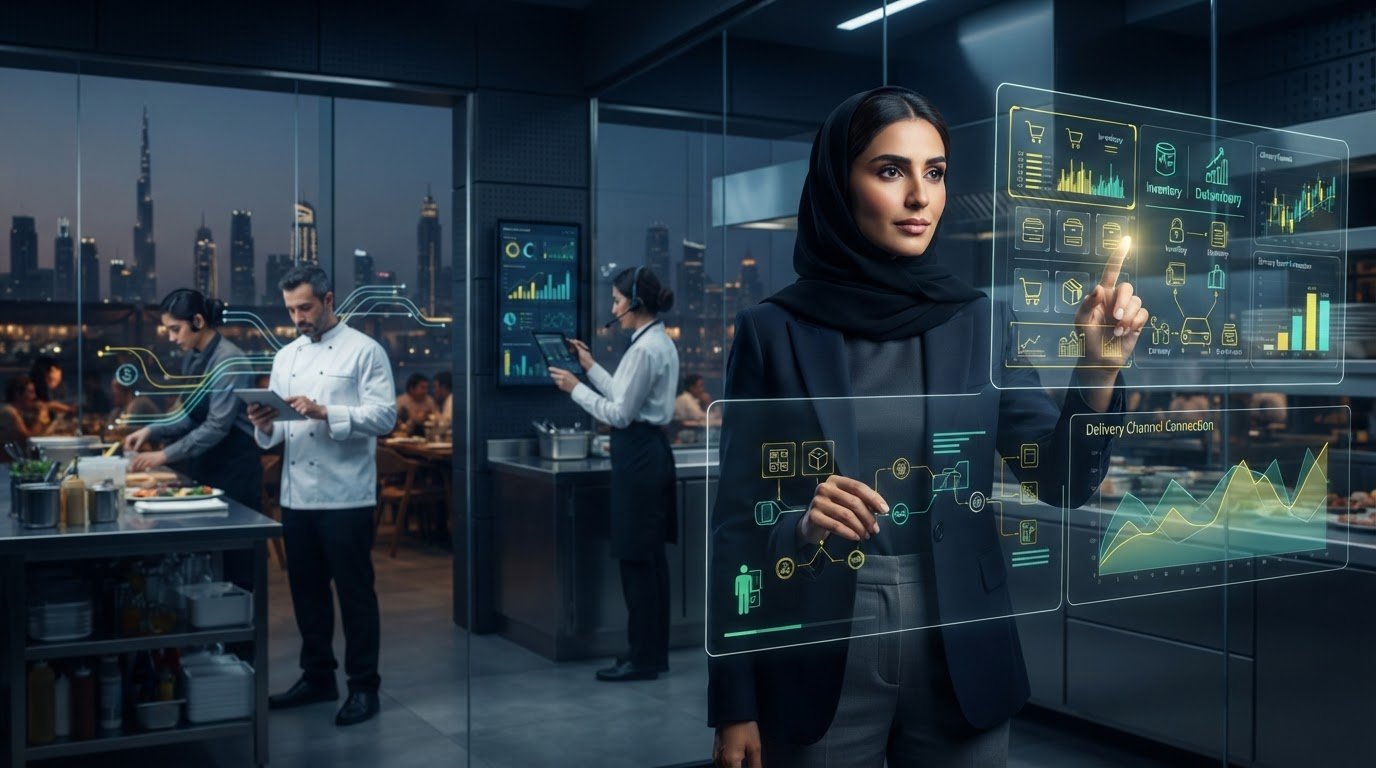
Centralized Restaurant Menu Control: The 2026 Strategy for UAE F&B Growth
In a market where 87% of UAE restaurant operators have already integrated AI into their workflows, simply having tech isn't a competitive edge anymore. The real victory belongs to those who possess total architectural authority over their digital presence. If you're still juggling multiple tablets to update a seasonal dish or manually 86ing items across Talabat and Deliveroo, you aren't just losing time; you're bleeding revenue through operational friction. Mastering centralized restaurant menu control is the only way to ensure your brand remains agile enough to scale from a single boutique in Jumeirah to a nationwide powerhouse.
It's exhausting to watch your kitchen staff battle order inaccuracies while you worry about complying with the latest Dubai Municipality calorie declarations or Abu Dhabi’s SEHHI healthy menu mandates. You know that manual entry is a relic that invites human error and guest frustration. This guide will show you how to implement a single command center to synchronize every price, description, and inventory level instantly. You'll learn to use tools like Atlas Menu Management and OmniSync to eliminate tablet clutter, reduce labor costs, and build a resilient infrastructure that turns every digital channel into a high-precision revenue stream.
Key Takeaways
- End "tablet hell" by consolidating fragmented delivery platforms into a single command center to slash manual order errors and kitchen stress.
- Master centralized restaurant menu control to synchronize prices and 86 out-of-stock items across Talabat, Deliveroo, and your POS instantly.
- Automate compliance with UAE mandates, including Abu Dhabi's SEHHI healthy options and Dubai’s calorie declarations, through a unified digital dashboard.
- Use middleware like OmniSync and Universal Bridge to connect legacy systems, allowing you to launch virtual brands across the Emirates in hours.
- Optimize your profitability by applying platform-specific dynamic pricing that accounts for varying aggregator commission fees.
The Cost of Fragmented Menu Management in UAE’s High-Volume Market
Managing a restaurant in Dubai or Abu Dhabi requires surgical precision. In a region where delivery aggregators account for a massive portion of total revenue, operational friction isn't just a nuisance. It’s a structural failure. Without centralized restaurant menu control, your business relies on a fragile web of manual updates. This fragmentation creates a "tablet hell" that drains your staff's energy and erodes your bottom line. You can't build a legacy on a foundation of disconnected devices.
The "Tablet Hell" and Kitchen Efficiency
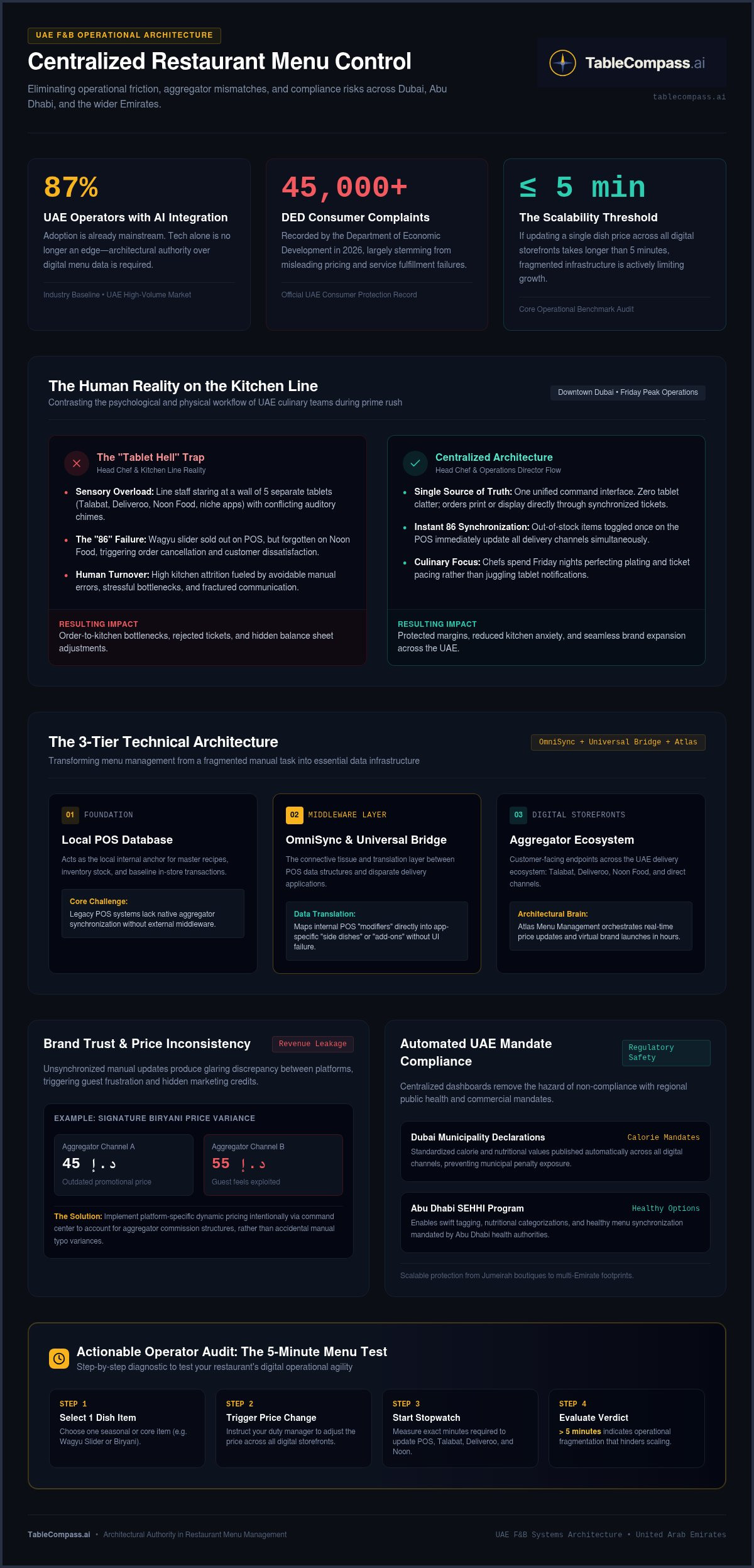
Picture a head chef in the middle of a Friday night rush in Downtown Dubai. Instead of focusing on plating, he's staring at a wall of five different tablets. Each one beeps with a different tone. One for Talabat, one for Deliveroo, another for Noon Food, and two more for niche platforms. This sensory overload is more than just noise; it’s a bottleneck that slows the "order-to-kitchen" flow. When systems are fragmented, your kitchen loses its rhythm. The psychological toll on staff is immense. High turnover in UAE kitchens is often driven by this avoidable operational chaos. Modern hospitality requires a unified architecture, moving beyond the limitations of modern point-of-sale (POS) systems that lack native aggregator synchronization.
Revenue Leakage from Manual Menu Errors
Manual entry is the primary catalyst for delivery order cancellations. If you "86" a popular wagyu slider on your POS but forget to update Noon Food, you're inviting a customer service disaster. The result is a rejected order and a frustrated guest. In 2026, the Department of Economic Development recorded over 45,000 consumer complaints in the UAE. Many were linked to misleading pricing or service failures. Using a command center like Atlas Menu Management ensures these errors never reach the customer. It acts as the central nervous system for your operations.
Inconsistency across platforms also kills brand trust. If a guest sees your Biryani for 45 د.إ on one app and 55 د.إ on another without explanation, they feel exploited. These financial leaks are often hidden. They're buried in monthly statements as "adjustments" or "marketing credits." Without OmniSync to bridge these gaps, you're essentially gambling with your reputation. Every manual update is a chance for a typo that costs you a customer.
Actionable Tip: Perform a "Menu Update Audit" this week. Time how many minutes it takes your manager to change a single price across every digital storefront. If it takes more than five minutes, your current infrastructure is hindering your ability to scale.
Defining Centralized Restaurant Menu Control: From Middleware to AI
To scale in the competitive UAE market, you must view your menu as more than a list of dishes. It is a data asset. Centralized restaurant menu control is the synchronization of price, availability, and description across all digital channels from a single source of truth. This architecture replaces the fragmented chaos of individual platform logins with a unified command center. By treating menu management as essential infrastructure, you eliminate the operational friction that limits growth. Research from Harvard Business School highlights The Cost of Fragmented Menu Management, noting how productivity suffers when systems don't talk to each other. In 2026, this connectivity is the difference between a high-performing brand and a struggling one.
The Anatomy of a Unified Menu System
A high-performance digital menu relies on a three-tier architecture. First, your Point of Sale (POS) acts as the local database. Second, middleware like OmniSync serves as the connective tissue. Finally, the aggregator platforms (Talabat, Deliveroo, Noon Food) serve as the customer-facing storefronts. Universal Bridge plays a critical role here by handling the translation of data between different software languages. It ensures that a "modifier" in your POS is correctly interpreted as a "side dish" or "add-on" on a delivery app. Without this translation layer, your digital storefront becomes a broken experience for the user. Systems like Atlas Menu Management function as the "Architectural Brain," ensuring that every update is structurally sound before it reaches the public.
Real-Time Synchronization vs. Batch Updates
In the fast-paced UAE market, "near-instant" updates aren't enough. If a kitchen in Dubai Marina runs out of a specific ingredient, that item must be removed from all platforms in seconds, not minutes. There's a vital technical difference between push-updates and pull-updates.
- Push-Updates: Your central system instantly sends new data to aggregators the moment a change is made.
- Pull-Updates: The aggregator platforms check your system for changes at scheduled intervals, often leading to delays.
The landscape has evolved. We've moved beyond simple syncing into the era of AI-driven optimization. With 87% of UAE restaurant operators now using AI in some form, data-driven decisions are the new standard. Tools like GuestConnect AI can analyze which menu items perform best during specific Dubai heatwaves or Abu Dhabi events. If you're ready to move beyond manual entry and embrace high-speed automation, exploring a unified system like Atlas Menu Management is the next logical step for your brand's evolution.
Eliminating Operational Friction: The Strategic Benefits of Unified Menus
In the high-velocity UAE market, speed is the ultimate currency. If your operational backbone isn't unified, you're moving too slowly. Centralized restaurant menu control transforms your menu from a static list into a dynamic engine for growth. It moves beyond the "tablet hell" mentioned earlier, allowing you to execute complex strategies with zero manual friction. When your infrastructure is synchronized, you aren't just reacting to orders; you're orchestrating a high-performance brand.
Scaling Virtual Brands and Ghost Kitchens
The rise of ghost kitchens in hubs like Al Quoz and Dubai Silicon Oasis has birthed the "one kitchen, ten menus" model. Managing distinct brand identities, each with its own pricing and modifiers, is impossible without a structural command center. Using the Atlas dashboard, you can launch a virtual brand across multiple aggregators in hours, not days. This agility lets you test new concepts, like a healthy "SEHHI" compliant line for Abu Dhabi, without hiring extra administrative staff. For a deeper dive into these operational shifts, consult our Centralized Menu Management: 2026 UAE Restaurant Guide. It's about building a scalable architecture that grows with your vision.
Optimizing Margins with Platform-Specific Pricing
Profitability in the UAE delivery space is a game of margins. Aggregator commission fees typically range from 15% to 30%. These costs can quickly cannibalize your profits if you use flat pricing across all channels. A unified system allows for platform-specific dynamic pricing. You can set your prices 10% higher on Talabat compared to your white-label mobile app to offset commission costs while remaining inclusive of the 5% VAT. This tiered strategy is essential for maintaining structural integrity in your finances. You can also deploy platform-exclusive promotions, like a "Noon Food Exclusive" bundle, directly from your dashboard without logging into separate portals.
Inventory integrity is the final piece of the puzzle. Automated "snoozing" ensures that when your last portion of Kunafa is sold, it disappears from all digital storefronts instantly. This prevents the negative ratings and refund requests that plague unoptimized businesses. By automating this process, you protect your brand's reputation and ensure your kitchen staff only focuses on orders they can actually fulfill. It's a silent partner that handles the heavy lifting in the background, keeping your operations seamless.
Actionable Tip: Use your centralized data to audit platform performance every month. You might find that high-margin appetizers sell best on Deliveroo, while family bundles dominate Talabat. Use these insights to tailor your digital storefronts for maximum profit rather than just volume.
Choosing Your Command Center: A Selection Framework for F&B Groups
Selecting the wrong infrastructure can cripple your operations. As an F&B group owner, you need a system that offers deep integration rather than superficial connectivity. True centralized restaurant menu control requires a platform that understands the complex relationships between ingredients, modifiers, and multi-channel pricing. If a software solution cannot handle deep data layers, it will eventually fail under operational pressure. You must evaluate potential partners based on technical capability and regional expertise.
Evaluating POS Compatibility
Your existing point-of-sale database is the foundation of your business. When connecting legacy systems to modern delivery applications, having a robust middleware layer is vital. This is why the Universal Bridge is critical for legacy systems; it acts as a translator between old and new software languages. When auditing providers, ensure they support a true "two-way" sync. This means the system must receive incoming orders while simultaneously pushing out real-time menu updates.
Verify that your provider supports all major UAE aggregators. Your checklist must include:
- Talabat
- Deliveroo
- Noon Food
- Smiles
The Human Element: Support and Implementation
Software is only as good as the team supporting it. When a critical menu error occurs during a chaotic Friday night rush in Dubai Marina, a global ticketing system is useless. You cannot afford to wait 24 hours for an automated email response while your kitchen loses money. Local UAE support is an operational necessity. Having access to a dedicated specialist who understands local market conditions ensures immediate resolution when things go wrong.
The implementation process requires a human touch. A dedicated TableCompass.ai specialist will guide your team through the initial setup, ensuring your menu architecture is clean and optimized. Training your restaurant staff to use the dashboard effectively is just as important as the software itself. When your managers feel confident using the technology, operational stress disappears. Ready to see how a unified infrastructure can transform your business? Book a live platform demonstration today to experience the power of total operational mastery.
Actionable Tip: Before signing a contract, ask for a "stress test" demo. Have the provider execute a complex menu update, such as changing a modifier price across three different platforms simultaneously, to prove their system can handle real-world pressure.
Implementing Atlas: Scaling Your Brand with Intelligent Menu Management
Scaling a restaurant brand in the UAE requires a fundamental shift in perspective. You aren't just selling food; you're managing a complex digital ecosystem. TableCompass.ai transforms fragmented data points into a cohesive growth engine. By implementing Atlas Menu Management, you replace reactive firefighting with proactive strategy. This transition represents the final step in achieving total operational mastery. It's about moving from a state of fragmented chaos to a vision of integrated order.
Future-Proofing with AI Integration
Future-proofing is no longer optional in the Emirates. With 87% of local operators leveraging AI, the competitive gap is widening every month. GuestConnect AI uses your existing menu data to drive high-margin direct orders through personalized engagement. Imagine a restaurant manager in Dubai Hills looking at a clear, unified dashboard with a smile. They aren't stressed about "tablet hell" because predictive inventory management anticipates shortages before they happen. This level of centralized restaurant menu control ensures that your digital storefront is always accurate, compliant, and profitable without requiring constant human oversight.
Your Digital Transformation Roadmap
Transitioning to a unified architecture follows a methodical three-step roadmap. First, we deploy OmniSync to integrate your existing POS with the Universal Bridge, creating the necessary connectivity. Second, we configure Atlas to serve as your single source of truth for all digital channels, from Talabat to your white-label app. Finally, we optimize your menus for local compliance, ensuring every item features the required SEHHI logos or calorie counts for Dubai Municipality standards.
2026 is the year of "Operational Integrity" for UAE hospitality. It's the year where the silent partners of automation handle the heavy lifting while you focus on the guest experience. The path to scaling starts with a single consultation. We'll map your restaurant’s digital workflow to identify every hidden leak and friction point. It's time to build a resilient foundation that supports your vision for growth. Scale your restaurant operations with TableCompass.ai and take command of your brand's future. By investing in structural infrastructure today, you ensure your brand remains a leader in the fast-moving UAE market for years to come.
Commanding the Future of UAE Hospitality
Operational fragmentation is a choice, not a market reality. Continuing to manage individual delivery tablets manually means accepting revenue leakage, high staff turnover, and compliance risks. True market leaders understand that centralized restaurant menu control is the structural foundation required to scale a brand across the Emirates. By unifying your digital storefronts, you protect your kitchen from chaos and ensure your pricing strategies remain highly profitable.
TableCompass.ai provides the essential infrastructure to transform your business into a high-performance engine. With Atlas Menu Management, you gain the UAE’s most robust menu engine to push real-time updates instantly. Our OmniSync middleware ensures seamless POS-aggregator connectivity, while our local UAE support stands ready to assist your team during high-stakes weekend rushes. It is time to replace operational stress with total technological mastery.
Taking control of your multi-channel operations is simpler than you think. You can eliminate manual errors, automate regulatory compliance, and position your brand for sustainable growth starting today. Your digital transformation roadmap is ready for execution. Master your menu with TableCompass.ai today and build a legacy of efficiency and growth in the region.
Frequently Asked Questions
What is centralized menu management for restaurants?
Centralized menu management is a unified digital architecture that allows you to control every aspect of your menu from a single dashboard. Instead of logging into separate portals for Talabat, Deliveroo, and your internal POS, you update a dish once. This master data then flows through middleware like OmniSync to every customer-facing channel. It functions as the structural brain of your operation, ensuring your brand identity remains consistent across the entire UAE digital ecosystem.
How does centralized menu control reduce delivery order errors?
It eliminates the primary cause of friction: human manual entry. By using a system like Atlas Menu Management, orders flow directly into your kitchen without a staff member re-typing them from a tablet. This automation removes the risk of typos, missed modifiers, or incorrect item selections. Since the menu data is synchronized, customers can only order exactly what is available in your kitchen, which drastically reduces the cancellation rates that hurt your platform rankings.
Can I manage different prices for Talabat and Deliveroo from one place?
Yes, you can implement platform-specific pricing strategies directly from your command center. This is essential in the UAE to offset varying aggregator commission fees, which typically range between 15% and 30%. You can set a base price for your dine-in POS and apply a percentage-based markup for specific delivery apps. This ensures your margins remain protected while you maintain a single point of operational control for all seasonal updates or tax adjustments.
Do I need to change my current POS system to use Atlas Menu Management?
You don't need to replace your existing infrastructure to gain total control. Our Universal Bridge middleware is designed to act as a translator for legacy systems, connecting them to modern aggregators and AI tools. Whether you're using a standard cloud POS or a specialized local system, we build the connective tissue required for synchronization. This allows you to modernize your operations without the heavy capital expense of a total hardware overhaul.
How long does it take to sync a menu change across all platforms?
Updates happen in near real-time through high-speed push synchronization. When you change a price or description in Atlas, the data is transmitted through OmniSync to all connected storefronts within seconds. This speed is vital for complying with UAE regulations like Dubai Municipality calorie mandates or Abu Dhabi’s SEHHI healthy menu requirements. You won't have to wait for batch updates or manual approvals, ensuring your digital presence is always accurate and compliant.
Is centralized menu control suitable for small restaurants in the UAE?
It's a strategic necessity for any business looking to scale, regardless of size. Small operators often have lean teams, meaning staff are overwhelmed by managing multiple tablets during peak hours. Implementing centralized restaurant menu control allows a single manager to handle the workload of a much larger team. It provides the technological foundation to compete with major F&B groups by ensuring operational precision and reducing the labor costs associated with manual order management.
What happens if one delivery platform goes offline during a sync?
The system is built with high structural integrity to handle platform outages. If an aggregator experiences downtime, OmniSync queues your updates and pushes them the moment the connection is restored. This ensures your menu data remains synchronized without manual intervention. You'll receive clear status alerts on your dashboard, allowing you to maintain full visibility over your digital storefronts even when external third-party services face technical challenges in the local market.
How does menu synchronization help with inventory management?
It acts as an automated gatekeeper for your stock levels. When a kitchen runs out of a specific ingredient, marking it as unavailable in your POS triggers an instant "86" command across all delivery channels. This prevents guests from ordering out-of-stock items, which is the leading cause of negative reviews and refund requests in the UAE. By automating inventory syncing, you protect your brand reputation and ensure kitchen workflows remain uninterrupted during high-pressure service periods.