Business Case for Restaurant Automation: Costs, Returns and Staffing
Restaurant automation is more likely to reshape people’s work than remove the need for people. In a survey, 90% of restaurants agreed that greater automation of back-of-house operations would let staff focus on more critical tasks, which is central to the business case for restaurant automation.
That doesn’t make every technology investment worthwhile. UAE restaurant operators still need to weigh costs against potential savings, sales opportunities, service improvements and time saved, while protecting the human touch guests value.
This article explains how automation can affect costs, revenue, customer service and staffing, and where it can or can’t replace human work. You’ll also see how to assess the business case for your restaurant, from connecting online orders and inventory to reducing repetitive tasks, so you can make a practical decision for your operation.
Key Takeaways
- Use sales and stock data together to spot likely shortages and over-ordering before they disrupt service.
- Bring online and in-person orders into a coordinated workflow to reduce manual re-entry and missed tickets.
- Assess automation by its effect on food costs, staff time, repeat sales and guest experience, not by speed alone.
- Automate repetitive tasks while keeping people focused on hospitality, judgment and situations that need a human response.
- When disconnected systems create extra work, explore tools such as OmniSync, Atlas Menu Management or GuestConnect AI to connect key parts of restaurant operations.
Will automation in restaurants ever replace human workers?
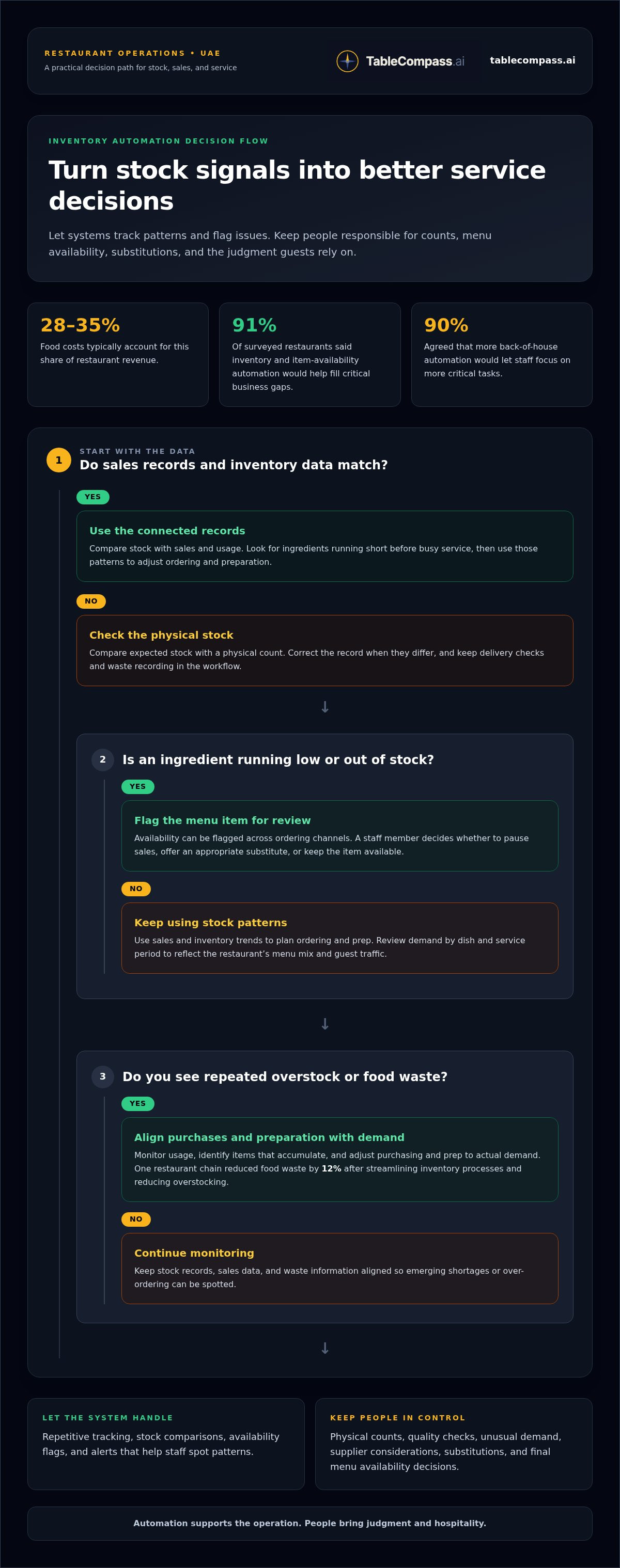
Automation is more likely to change restaurant roles than remove the need for people. In a survey, 91% of restaurants said inventory and item-availability automation would help fill critical business gaps. The distinction matters: software can flag a low stock level, but a kitchen team still decides how to handle substitutions, quality concerns, and unusual demand.
Food-cost control is a practical place to begin. Food costs typically account for 28-35% of restaurant revenue, so inaccurate counts and excess ordering can quickly affect margins. Inventory management tools compare recorded stock with sales and usage, then help operators spot patterns such as ingredients running short before a busy service. Managers can use those patterns to adjust ordering and prep, rather than relying only on memory.
Connect sales records to inventory data, and availability updates can follow stock changes. For example, if a menu item depends on an ingredient that has run out, an availability system can flag the item for review across ordering channels. Staff can then decide whether to pause sales, offer an appropriate substitute, or keep the item available. This reduces errors caused by menus showing dishes the kitchen cannot prepare.
A Kitchen Display System (KDS) can show live orders, prep times and status updates, helping the team coordinate incoming work. Linked inventory records show how sales affect stock and which ingredients need attention. These tools do not replace checking deliveries, recording waste or investigating mismatches. Compare expected stock with a physical count, then correct the record when they differ.
Better inventory management can also reduce food waste without automating every kitchen task. One restaurant chain reduced food waste by 12% after streamlining inventory processes and reducing overstocking. The useful lesson is the process: monitor usage, identify items that accumulate, and align purchases and preparation with actual demand. For a UAE restaurant, review demand by dish and service period, since menu mix and guest traffic shape what the kitchen needs.
Automation can handle repetitive tracking and alerts, while people provide judgment and hospitality. A system can show a stock trend, but a chef knows whether an ingredient can be used in another dish. Managers can weigh supplier quality, delivery timing and guest expectations. Use inventory tools to support operations, and assign staff clear responsibility for counts, waste records and final menu availability decisions.
Online order integration and automated delivery
Restaurants can automate order capture, payment routing, kitchen ticketing and selected delivery updates. POS middleware connects restaurant POS systems with food aggregators, automating order processing and inventory management to reduce manual entry and errors.
Online Ordering and Self-Service
First-party online ordering lets guests place orders directly through a restaurant’s own digital channel, while self-service kiosks let diners choose and pay on-site. Both can reduce manual order entry and give guests more control over browsing, customising, and paying. For a UAE restaurant serving dine-in, takeaway, and delivery customers, make sure menus and item availability stay aligned across the channels guests use.
Self-service works best when it complements staff rather than replacing hospitality. QR Table Ordering & Pay lets guests order and pay at the table, while employees can answer menu questions and support anyone who needs help. Review the journey from menu selection to payment confirmation. If guests repeatedly need staff intervention at the same step, clarify the options or improve the menu information.
Automated Ordering, Payments, and Kitchen Operations
Restaurant automation can capture orders, process payments, send tickets to kitchen displays and coordinate order status across channels. Disconnected steps can lead to re-entry errors, delayed tickets and confusion between front-of-house and kitchen teams. Map the journey from order placement to handoff, then identify where staff copy details or switch screens.
Integration depends on systems sharing accurate information. A POS can consolidate in-restaurant and online orders into one ticketing workflow; inventory data can inform item availability, while accounting tools can receive transaction records. Delivery-platform connections can pass incoming orders into operations. The specific connection depends on the platforms and the data they exchange, so map order details, payments, refunds, and sales totals before implementation.
Value stream mapping makes that workflow visible. Trace one order from a guest’s phone or kiosk to payment, kitchen preparation, packing, and handoff. Mark each wait, repeated entry, and correction. A major quick-service chain cut peak-hour service times by 15% using value stream mapping. The practical lesson is to fix the bottleneck first, not automate every step at once.
Automation also supports delivery without replacing the restaurant’s team or the delivery provider. A connected workflow can route an incoming order, show its preparation status, and keep the kitchen working from a consistent ticket. In a survey, 62% of restaurants said automation could fill critical gaps in managing online, in-restaurant, and delivery-app orders. Track missed tickets and order corrections to see where integration helps.
Choose one busy service period to review first. Compare order entry, payment completion, kitchen ticket accuracy, and handoff delays across dine-in, takeaway, and delivery. If disconnected channels are creating extra steps, integrated ordering workflows can help bring those operations into a more coordinated flow.
Restaurant automation's effects on costs, sales and customer service
Automation can reshape costs and service by reducing repetitive work and making customer interactions more consistent. For UAE restaurant owners, the useful test is whether a tool improves a measurable process without weakening the guest experience.
Self-Service Point-of-Sale Systems
Self-service lets guests select items, customise orders and pay through a digital channel, including QR Table Ordering & Pay. Clear order capture can reduce manual entry and leave employees more time to support guests who need personal help.
Measure the effect across the full process, not only at payment. Compare order corrections, handoff delays and staff involvement before and after introducing a digital ordering channel. A smoother checkout has limited value if unclear menu information leads to abandoned orders or kitchen changes.
Automation can also influence sales through menu presentation. Atlas centralises menu control across digital channels, while staff remain available to make recommendations. Review which items guests select and where they pause, then improve menu information and ordering flow. Keep personal assistance available for guests who prefer speaking with a team member.
Customer Service Effects
Restaurant automation can make routine steps, such as capturing an order or confirming payment, more consistent. That can smooth the customer experience while employees focus on questions, special requests and service recovery.
Robotic food servers can transport meals from the kitchen to tables, but people still handle guest interaction and exceptions. A robotic unit may help move dishes along a set route; a server can check that the right meal reaches the right guest and respond if an order needs attention.
Service quality depends on how the processes connect. A restaurant chain reduced service errors by 15% after using standard operating procedures. The practical takeaway is to pair automation with clear steps for staff: who handles a failed payment, an incorrect ticket, or a delayed dish? Review guest feedback and correction records together, rather than treating technology as a substitute for attentive service.
Costs, ROI, and Payback
Automation costs in the UAE depend on the project scope, systems, integrations, equipment, training, and ongoing charges. The price depends on the case and is given after a quote request; assess these cost factors against the tasks and processes the investment will address.
ROI compares the value created with the total investment. Track measurable changes such as labour hours, food costs, order errors, and repeat sales. One restaurant chain reduced food costs by 12% after implementing POS, inventory management, and customer engagement technologies. Another increased repeat business by 8% through targeted marketing.
There is no single payback period that fits every restaurant. Calculate the time required for cumulative savings and added revenue to recover setup and operating costs. A reported 10% reduction in labour costs through Precision Labour Deployment illustrates one possible outcome, not a forecast for every UAE operation. Compare results with your own baseline, service standards, and sales mix.
UAE restaurant operators should map payment processing and customer-data flows against the requirements that apply to their activities. The relevant controls depend on what data a system handles and how payments are processed, so include these considerations when assessing implementation.
Automation's effects on restaurant staffing
Restaurant automation changes how teams spend their time, but it doesn’t remove the need for skilled employees. A survey of more than 600 hospitality professionals found 38% wanted AI to help with scheduling and labour. For UAE operators, the staffing opportunity is better coordination: fewer repetitive tasks, clearer shift plans, and more time for guests.
Start with unnecessary movement. A quick-service chain reduced the distance chefs travelled between kitchen stations by 30% using spaghetti diagrams. These diagrams map staff movement during a real service. Observe one busy shift, mark trips for ingredients, utensils, and order checks, then rearrange workstations or supplies to remove avoidable crossings. Less walking can help chefs keep attention on preparation and timing.
Scheduling software can bring shift planning, availability, overtime and rest periods into one view. Managers can spot staffing gaps before publishing a rota and adjust coverage around expected service needs. Compare reservation patterns and past order volumes with staff availability, then schedule experienced employees for busy kitchen or service periods. Keep a manager responsible for reviewing changes and communicating the final schedule.
Flexibility also matters to staff wellbeing. In a study of non-office workers, 53% of workers without sufficient flexibility said they were burned out, compared with 37% who felt they had enough flexibility. A scheduling tool can help managers consider employee preferences when assigning shifts. Invite staff to submit availability before the rota is built, then address conflicts before they disrupt restaurant operations.
Automation should shift repetitive work, not simply reduce headcount. A kitchen display can make ticket priorities visible, while a team member checks special requests and coordinates exceptions. Inventory alerts can flag a shortage, but chefs still decide whether to adjust preparation or recommend another dish. Define which decisions remain with people before implementation, especially where food quality or guest needs require judgment.
Use a short operational review to identify where staff time goes. Track delays and failed handoffs, then test one workflow, such as shift communication or kitchen station coordination, and gather feedback from the people using it. A restaurant management system can support shared operational information, but its value depends on accurate inputs and clear staff ownership.
For UAE restaurants, build schedules around actual opening hours, expected demand, employee availability, and applicable workplace requirements. Review the rota when operating patterns or requirements change. When software handles routine coordination, managers can focus on coaching, service standards, and the human preferences that shape a strong team.
Restaurant automation adoption and business case
Adoption alone doesn’t prove an investment pays off. Restaurant profit margins usually range from 3% to 5%, so improving a manual process can matter, but only when the change creates measurable value. A business case for restaurant automation should connect each tool to a specific operational need, such as reducing repeated data entry or making service information easier to manage.
Technology is already part of restaurant operations. 76% of restaurants have adopted at least three automated tools. That figure signals widespread use, not a guaranteed return for every operator. The Square 2024 Future of Restaurants report found that 54% of restaurant owners planned to increase spending on technology and automation tools over the next 12 months compared with the previous year. The key is choosing tools that address an identifiable bottleneck.
Build the case around a clear baseline. Record how a process works before changing it, then track the same measures afterward. If employees manually transfer sales information between systems, document the time spent and corrections required. If campaigns rely on manual guest segmentation, identify how the team selects audiences and reviews results. These measures help restaurant owners assess whether automation is improving work.
Include the full cost of implementation in the decision. Consider setup, integration, training, ongoing fees and staff time needed to manage the system. Compare these costs with expected gains, such as fewer errors, smoother handoffs or more consistent reporting. An enterprise platform is not automatically the best fit. A smaller operation may need one well-integrated workflow, while a multi-location group may benefit from shared controls.
Adoption can also reflect resilience. During the pandemic, 87% of industry and restaurant operators agreed that technology adoption was critical. That finding describes the period, not a current return forecast. For a UAE business, use local operating patterns, service mix, and the systems already in use to decide which processes deserve attention. Start with a defined workflow, assign an employee to own the review, and set a regular point to assess the results.
Integration deserves particular scrutiny. The Square 2022 Future of Restaurants report found that 30% of restaurants used a single integrated application to manage back-of-house operations. This offers a useful comparison when fragmented tools create duplicate manual work. Map which systems need to exchange information, who relies on each output, and where errors currently enter. Then prioritise a connection that removes a real operational friction point.
To turn these criteria into a practical plan, assess your restaurant’s automation priorities against the workflows and systems you want to improve.
TableCompass.ai: OmniSync
TableCompass.ai helps restaurants connect operational systems when disconnected tools create extra manual work. OmniSync connects restaurant POS systems with food aggregators, automating order processing and inventory management. It’s a useful fit when staff repeatedly enter orders manually or manage information across separate platforms.
Other TableCompass.ai tools address related needs: Atlas centralises menu control across digital channels, while GuestConnect AI supports customer interactions through automation. The White-Label App gives restaurants a branded channel for direct orders. Choose according to the operational gap you identified, whether that’s disconnected order flows, menu management or guest engagement.
To discuss which approach fits your restaurant’s automation priorities, contact TableCompass.ai.
Build your next step around one clear operational goal
The strongest business case for restaurant automation starts with a specific friction point, not a broad promise of transformation. Choose the workflow that consumes attention or interrupts service, then define what a better outcome would look like for your UAE restaurant. This focus keeps the human side of hospitality central while you decide where technology can support the team.
Map the systems and people involved in that workflow. TableCompass.ai offers OmniSync, Atlas and GuestConnect AI for different restaurant technology needs. The right starting point depends on whether your main challenge is connecting order flows, controlling menus across channels or supporting customer interactions.
Bring your priority workflow and desired outcome into the discussion, and contact TableCompass.ai to discuss automation. A clear first step can turn a complex technology decision into a practical plan, giving your team a stronger foundation for the next stage of service.
Frequently Asked Questions
Restaurant automation for improved efficiency: where to start?
Start with one recurring task that slows service or creates avoidable rework. Observe how a takeaway order moves from a delivery platform to the kitchen, and note where details are entered twice. Set a baseline using measures such as correction frequency, handoff delays or staff time spent on the task. Address the clearest bottleneck before expanding automation to other workflows.
What are the downsides of automation?
Automation can add complexity if it doesn’t fit existing restaurant processes. Staff may need training, integrations require coordination, and inaccurate menu or stock data can affect guest-facing channels. Digital ordering can also feel impersonal if guests can’t easily get help. In a UAE restaurant, plan who handles exceptions, how employees learn the workflow and what the team does if a system is unavailable.
What are the main business benefits of restaurant automation?
The main benefits are fewer repetitive steps, clearer operating information and more consistent service processes. A manager, for example, can use operational information to spot recurring order corrections, then improve staff guidance or menu details. Automation can also help coordinate information across channels, reducing the need to switch between disconnected tasks. The best benefit is the one that resolves a specific operational issue without making guest service harder.
How much can restaurant automation reduce labor costs, errors, and food waste?
There isn’t one reduction figure that applies to every restaurant. Measure labour by task time and staffing hours, errors by corrections or remakes, and food waste through recorded discarded ingredients. Compare each measure under similar operating conditions after implementation. Separate changes linked to automation from those caused by menu changes, supplier issues or shifts in demand. This gives operators a clearer view of where value is being created.
How do restaurant automation systems compare with hiring additional staff?
Hiring adds people who can adapt, make judgments and provide personal service; automation can handle repeatable information tasks. A restaurant facing a queue may need more staff for guest assistance, while repeated order entry may point to a system connection issue. Compare both options against the specific pressure point, including training, supervision, software upkeep and the human attention guests expect.
What are the risks and challenges of automating a restaurant?
Common challenges include poor data quality, disconnected systems, staff resistance and unclear responsibility when exceptions occur. An outdated menu entry, for instance, can confuse guests even if order routing works correctly. Before launch, assign someone to maintain key information, train employees using real service examples and define a manual fallback for disruptions. UAE restaurants should also consider how each system handles operational and customer information.
How should a restaurant assess, choose, and implement automation solutions?
Define the problem first, then map the people, systems and information involved. Compare solutions by how well they fit existing workflows, the integrations they require, staff training needs and the measures they can help improve. Pilot the selected process in a controlled part of restaurant operations, gather employee feedback and review baseline measures. Expand only when the team understands the new workflow and can handle common exceptions.