AI Inventory Management: 2026 Guide for UAE F&B Groups
Imagine a Friday night rush in Downtown Dubai where your Talabat tablet accepts three orders for a signature dish your kitchen actually sold out of twenty minutes ago. This "inventory drift" is more than a minor headache. It's a structural leak in your profitability that manual stocktaking simply cannot plug. You likely feel the constant pressure of keeping your POS in sync with your delivery channels while managing 2026 requirements like the Nutri-Mark labeling and ZAD system registration. It's an exhausting balancing act that often leads to wasted hours and lost revenue.
This guide will teach you how to master ai restaurant inventory management to eliminate these discrepancies forever. You'll learn how to build a synchronized digital bridge that connects your back-of-house reality with your digital storefronts on Deliveroo and Talabat. We'll explore the architecture of modern stock control, showing you how tools like OmniSync and Atlas Menu Management act as a central brain to automate procurement and protect your margins. We're moving from a state of fragmented chaos to a vision of integrated, high-speed order.
Key Takeaways
- Learn how to eliminate "inventory drift" by ensuring your physical stock levels automatically sync across Talabat, Deliveroo, and your POS system.
- Discover how to replace hours of manual data entry with AI-driven scanning that digitizes invoices and updates your pantry levels in real-time.
- Understand why integrated middleware is the superior choice for ai restaurant inventory management over standalone apps that often create disconnected data silos.
- Follow a practical roadmap to audit your current kitchen operations and transition to a unified digital architecture that supports long-term growth.
- Explore how localized UAE solutions like OmniSync help you maintain total operational control while staying compliant with 2026 food safety and labeling regulations.
Beyond the Spreadsheet: Solving Inventory Drift in the UAE F&B Market
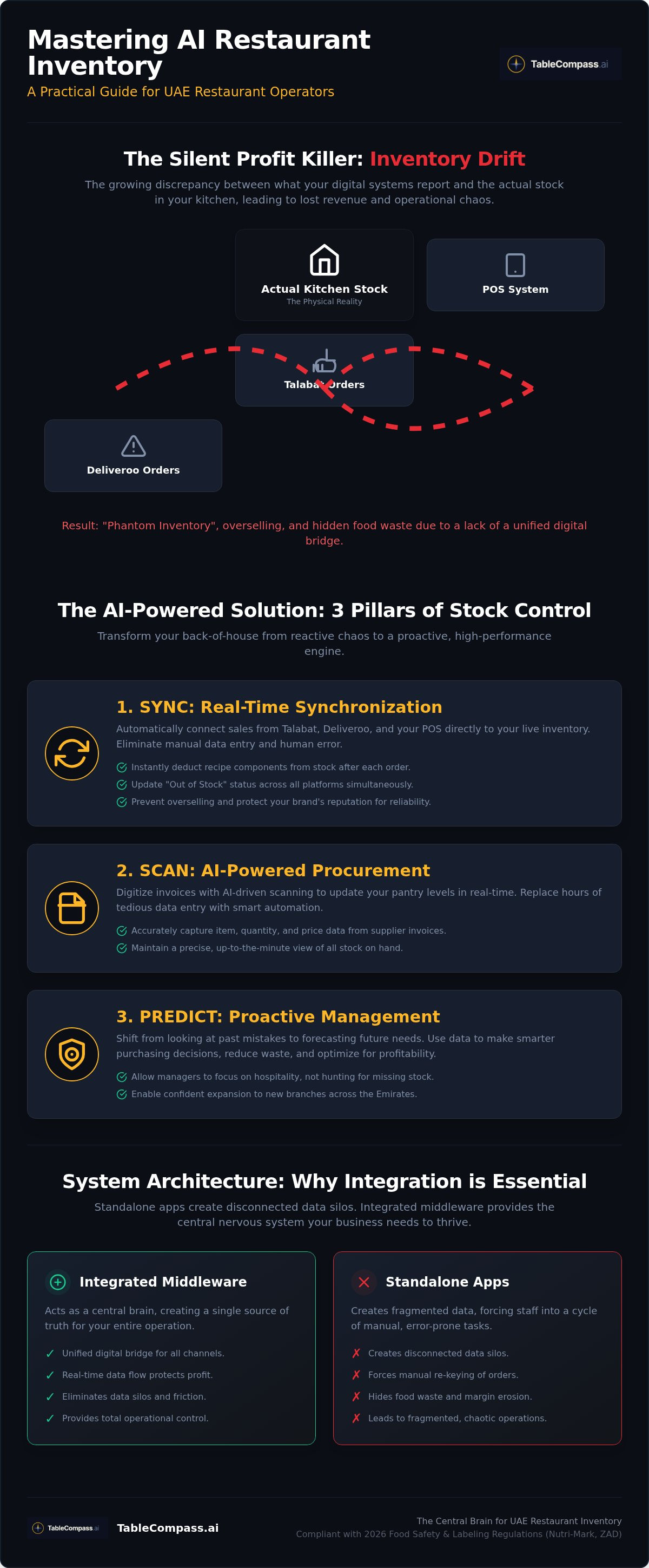
In the high-stakes UAE F&B market, "Inventory Drift" is the silent predator of your bottom line. It's the growing discrepancy between the digital sales recorded on your screen and the physical stock actually sitting in your chillers. For high-volume groups in Dubai and Abu Dhabi, manual entry is no longer a viable strategy; it's a direct route to margin erosion. When senior staff spend hours every week manually reconciling counts, they aren't just performing a chore. They're struggling to maintain inventory control systems that were never designed for the complexity of 2026.
You need a structural foundation that replaces operational chaos with technological mastery. This is why ai restaurant inventory management is now considered essential infrastructure rather than an optional tool. It provides the architectural integrity required to manage multi-branch operations without losing a single dirham to unrecorded waste. By centralizing your data, you turn a fragmented back-of-house into a high-performance engine.
The Aggregator Paradox: Talabat, Deliveroo, and Your Stock
UAE operators manage some of the highest delivery volumes in the world. However, the "Aggregator Paradox" remains a major hurdle: more sales often lead to less clarity. Every order from Talabat, Deliveroo, or Noon that isn't instantly synced creates "phantom inventory." Your POS thinks you have five kilos of wagyu beef, but your kitchen knows it's already gone. This lack of a unified digital bridge forces staff into a cycle of manual re-keying, which is where the most expensive errors occur.
Tablet clutter does more than take up space; it fragments your data. When your delivery channels and your back-of-house don't speak the same language, food waste stays hidden in the gaps. Solving this requires more than just better habits. It requires a middleware solution like Universal Bridge to ensure every dirham of stock is accounted for in real-time, protecting your profit from the friction of disconnected systems.
Anatomy of AI Inventory Management
Modern ai restaurant inventory management functions as the central nervous system of your business. It shifts your team from reactive counting to proactive synchronization. Instead of looking backward at what went wrong last month, you gain the ability to see exactly what's happening across your entire group right now. This is the difference between surviving the rush and mastering it. It allows your managers to focus on hospitality rather than hunting for missing stock.
By utilizing OmniSync as your "silent partner," you eliminate the heavy lifting of manual tracking. The system handles the complex calculations of recipe depletion and stock levels automatically. This transition from spreadsheets to real-time operational mastery empowers you to scale with confidence. You can expand to new branches across the Emirates knowing your internal mechanics are rock-solid, fully optimized, and ready for the demands of a digital-first economy.
The Three Pillars of AI-Driven Stock Control: Sync, Scan, and Predict
To achieve total operational control, your back-of-house needs more than just a digital list. It requires a structural framework built on three specific pillars: Sync, Scan, and Predict. These elements work in tandem to transform your kitchen from a reactive environment into a high-performance engine. When your digital storefronts match your physical pantry, you eliminate the friction that typically slows down UAE F&B groups. This integrated approach ensures that every ingredient is accounted for, from the moment it enters your loading dock to the second it's delivered to a customer in Dubai Marina.
Real-Time Synchronization: The OmniSync Advantage
The first pillar is absolute connectivity. OmniSync acts as the silent partner that automates the flow of data from Talabat and Deliveroo directly into your inventory records. This eliminates the need for manual data entry, which is the primary source of human error in high-volume kitchens. When a customer orders a specific dish, the system instantly deducts the exact recipe components from your stock levels. If an item runs low, the system updates your "Out of Stock" status across all platforms simultaneously. This prevents the frustration of overselling and protects your brand's reputation for reliability.
AI Invoice Scanning and Procurement
The second pillar focuses on the intake of goods. Modern ai restaurant inventory management utilizes computer vision to read supplier invoices with pinpoint accuracy. This technology tracks price fluctuations in real-time, alerting you if your supplier in Sharjah has increased the cost of poultry or greens. By automating the transition from paper to digital, you build a rock-solid audit trail for every ingredient. This allows you to compare theoretical usage against actual stock on hand, highlighting exactly where waste or theft might be occurring. If you want to see how this level of transparency can stabilize your margins, consider how integrated restaurant management software can unify your procurement cycle.
The final pillar is predictive intelligence. By leveraging historical sales data, the AI forecasts your future prep levels and ordering needs. It doesn't just tell you what you have; it tells you what you'll need for the upcoming weekend rush. This proactive ordering reduces food waste by ensuring you aren't overstocked on perishables. In the UAE's competitive market, this level of foresight is what separates market leaders from those struggling with inconsistent margins. You move away from guesswork and toward a data-driven strategy that guarantees your kitchen is always prepared, but never wasteful.
Evaluating AI Inventory Solutions: Standalone Apps vs. Integrated Middleware
Choosing the right technology for your group isn't just about picking the flashiest app. Many UAE operators fall into the "Silo Trap." This happens when you add a standalone counting tool that works in isolation from your main operations. While these apps might count stock faster than a pen and paper, they don't solve the underlying synchronization problem. If your inventory tool doesn't communicate with your point-of-sale, you're just creating a new digital island. You'll still end up with data gaps that require manual reconciliation at the end of every week, costing your managers valuable time in AED.
Effective ai restaurant inventory management requires a system that functions as a "Universal Bridge." For a multi-branch group in Abu Dhabi or Dubai, the Total Cost of Ownership (TCO) is a critical factor. Traditional inventory systems often require expensive proprietary hardware and complex on-site installations. Modern, hardware-free AI solutions leverage the mobile devices your team already owns. This eliminates the need for massive upfront capital expenditure while providing a more flexible, scalable infrastructure that grows alongside your business.
Why Integration is the Key to Structural Integrity
Structural integrity in a kitchen's data flow means every transaction is recorded everywhere, instantly. When your inventory software remains disconnected from your POS, you risk running on outdated information. Integrated systems like Universal Bridge ensure that a sale on a delivery tablet is immediately reflected in your stock levels. This level of connectivity is what prevents "phantom stock" from appearing in your records. For a deeper look at how this works in the local market, check out our POS middleware hospitality UAE guide.
User Experience for Local Kitchen Teams
Technology should empower your staff, not confuse them. UAE kitchens are melting pots of diversity, which means your interface must be intuitive and accessible to everyone. A mobile-first approach is essential. Your team needs to be able to perform counts directly in the walk-in freezer or dry store using a handheld device without struggling with complex menus. When the workflow is automated and easy to follow, training time drops significantly. You don't need data scientists; you need a tool that feels like a natural extension of the kitchen's daily rhythm. This human-centric design ensures that your ai restaurant inventory management strategy actually gets implemented on the floor rather than gathering digital dust in a back office.
A Practical Roadmap for Implementing AI Inventory in UAE Kitchens
Transitioning to a high-performance kitchen requires a methodical approach. It is not enough to simply purchase software; you must rebuild the architecture of your operations. Your transformation begins with a rigorous audit of the current "tablet clutter" on your counters. Most UAE groups juggle five or more aggregator devices, each representing a potential data leak. Identifying these gaps allows you to see exactly where stock is disappearing. Once the leaks are identified, you can select a middleware solution that serves as a structural anchor for your Talabat and Noon integrations, ensuring every order is captured in your central records.
Training the "human engine" is the next critical step. Your staff are the operators of this new technology; they must feel empowered by it. Instead of viewing AI as a monitoring tool, present it as a silent partner that eliminates the drudgery of manual counting. By setting up automated par levels and low-stock alerts, you remove the stress of last-minute ordering. Finally, you must review the AI-generated insights to optimize your menu engineering. This data-driven approach ensures you are doubling down on high-margin items while cutting ties with dishes that drain your profitability in AED.
Phase One: Bridging the Digital Divide
The first phase focuses on data cleanliness. You must begin by mapping every menu item within Atlas Menu Management. This creates a single source of truth for your recipes across all platforms. By connecting your POS directly to aggregator streams, you ensure a clean flow of data that reflects your actual sales. This phase is also the time to establish your baseline food cost percentage. Without an accurate starting point, you cannot measure the structural improvements the AI brings to your bottom line. It's about moving from guesswork to precision.
Phase Two: Scaling with Intelligence
Once your foundation is solid, you can begin scaling with intelligence. Implementing Satellite AI allows you to optimize digital workflows, identifying bottlenecks in your prep or delivery lines that lead to waste. This level of granular data gives you the leverage needed to negotiate better rates with local UAE suppliers. When you can prove your exact usage patterns, you move from a position of request to a position of market power. You can also shift from exhausting weekly stocktakes to fast, AI-assisted daily spot checks. This keeps your inventory accuracy high and your team focused on the guest experience. Ready to stabilize your back-of-house? Explore our restaurant management software to begin your transformation.
TableCompass Atlas: The Central Brain for UAE Restaurant Inventory
TableCompass.ai Atlas functions as the structural anchor for your entire F&B operation. It isn't just software; it's the central brain that synchronizes your physical inventory with your digital presence across the Emirates. When you deploy ai restaurant inventory management through Atlas, you're installing a command center that unifies your back-of-house with your front-of-house. For UAE groups, having a localized partner who understands the specific pressure of high-volume delivery in Dubai or Abu Dhabi is a decisive advantage. This localized specialization ensures your tech stack is built for the regional market's unique aggregator ecosystem.
By centralizing your data, you transform inventory from a tedious chore into a strategic growth engine. You gain the clarity needed to make bold moves, whether that's expanding to a new dark kitchen in Sharjah or optimizing your menu for the next tourist season. The system handles the complex heavy lifting in the background, allowing you to focus on the art of hospitality. It's time to replace operational stress with technological mastery and reclaim the margins you've been losing to manual errors and data gaps.
OmniSync: The Silent Partner in Your Kitchen
OmniSync serves as the high-speed link between your physical stock and your digital storefronts. By automating the synchronization of every Talabat order with your inventory, it ensures your digital presence is always a perfect reflection of your pantry. This eliminates the exhausting need for manual re-entry and late-night reconciliations that drain your managers' energy and lead to costly mistakes. Achieving seamless restaurant POS synchronization means your team can finally trust the numbers on their screens, allowing for a more efficient and decisive kitchen environment.
GuestConnect AI and Beyond
Inventory accuracy is the foundation of guest trust and engagement. When your ai restaurant inventory management system is functioning at peak efficiency, it fuels better interactions through GuestConnect AI. For instance, ensuring your White-Label Mobile App always shows real-time availability prevents the disappointment of a guest ordering a dish that's actually out of stock. This level of reliability is what builds long-term loyalty in the competitive UAE market. Future-proofing your restaurant group requires a unified tech stack where every component, from the guest app to the loading dock, works in harmony. Booking a demo to see the Universal Bridge in action is your next step toward total operational control and a more profitable, high-performance future.
Secure Your Margins with a Synchronized Digital Architecture
The era of manual stocktaking and "inventory drift" is coming to an end for the UAE's most successful F&B groups. By adopting ai restaurant inventory management, you're not just buying a tool; you're installing a structural engine that protects your profitability. You've seen how the pillars of synchronization and predictive intelligence eliminate the gaps between your physical pantry and your digital storefronts on Talabat, Deliveroo, and Noon. This is the essential infrastructure your business needs to scale with confidence across the Emirates.
It's time to replace operational stress with technological mastery. TableCompass OmniSync provides the essential middleware required to unify your POS with every delivery channel, ensuring your data remains rock-solid and reliable. Join the leading restaurant operators in the region who have already moved beyond the spreadsheet to embrace a vision of integrated order. Book a Demo of TableCompass OmniSync today to see the Universal Bridge in action. Your journey toward real-time accuracy and higher profit margins starts with a single, powerful connection.
Frequently Asked Questions
What is AI inventory management for restaurants?
It is a digital ecosystem that uses machine learning to automate stock tracking and replenishment. Unlike traditional methods, ai restaurant inventory management synchronizes your physical stock with digital sales channels in real-time. This eliminates "inventory drift" by ensuring every order from your POS or delivery tablets automatically deducts ingredients from your pantry. It provides absolute visibility into your food costs and usage patterns without the need for manual counting.
How does AI inventory software integrate with UAE delivery apps like Talabat?
Integration happens through specialized middleware like TableCompass OmniSync. This "Universal Bridge" connects your POS system directly to aggregator streams from Talabat, Deliveroo, and Noon. When an order is placed on a delivery tablet, the data flows instantly into your central inventory hub. This eliminates the need for staff to manually re-key orders. It ensures your stock levels are updated across all platforms simultaneously to prevent the frustration of overselling.
Can AI inventory management help reduce food waste in UAE kitchens?
Yes, it significantly reduces waste by providing precise, data-driven insights into your stock levels. By tracking theoretical versus actual usage, the system identifies discrepancies that suggest spoilage or theft. In the UAE, where cold chain integrity is vital, AI tools like Satellite AI help monitor consumption rates against expiry dates. This ensures you only prep what you sell, which directly improves your profit margins in AED and supports local sustainability regulations.
Do I need special hardware to use AI restaurant inventory tools?
No, TableCompass solutions are designed to be hardware-free. You don't need to purchase proprietary handheld scanners or expensive terminals. The software runs on the mobile devices and tablets your team already uses in the kitchen. This mobile-first approach allows staff to perform spot checks in walk-in freezers or dry stores using their own smartphones. It makes the transition to digital stock control both cost-effective and highly accessible for your entire culinary team.
How long does it take to implement an AI inventory system like TableCompass?
Implementation typically follows a structured roadmap that can be completed in a matter of weeks. The process begins with mapping your menu items in Atlas Menu Management and connecting your existing POS to our middleware. Because the system is cloud-based and hardware-free, there's no lengthy on-site installation required. Your team can start seeing real-time synchronization and automated stock alerts shortly after the initial data audit and staff training are finalized.
Will AI inventory management work with my existing POS system?
TableCompass is built on a "Universal Bridge" architecture specifically designed to integrate with major POS systems used across the UAE. Our middleware acts as a translator between your current software and third-party aggregators. This ensures that your existing investment remains protected while adding a layer of sophisticated ai restaurant inventory management. We recommend booking a demo to verify the specific compatibility list for your current setup and ensure a seamless data flow.
Can AI predict when I need to reorder stock from my suppliers?
The system uses historical sales data and current inventory levels to forecast future needs accurately. It recognizes patterns, such as increased demand during Dubai's tourist season or weekend rushes, and automatically calculates the necessary par levels. When stock reaches a specific threshold, the AI triggers low-stock alerts. This proactive procurement helps you negotiate better rates with local suppliers by providing clear evidence of your consistent volume requirements and reducing emergency last-minute purchases.
Is AI inventory management suitable for single-location restaurants in Dubai?
While high-volume groups see the most dramatic results, single-location operators benefit significantly from the time saved on manual reconciliations. Even a single outlet in a competitive area like JLT or Business Bay faces the challenge of managing multiple delivery tablets. AI-driven synchronization ensures that a small team can focus on the guest experience rather than being buried in spreadsheets. It's a vital tool for any operator looking to scale their business efficiently.